Back To Home

Marketplacer vs Yo!Kart: Find the Best eCommerce Software to Launch Your Marketplace
437
Views
Planning to launch your multi-vendor marketplace using a white-label eCommerce software? That’s a great idea to tap into this unprecedented eCommerce world, where businesses are achieving new heights every day. Of course, you can also become the next Amazon, eBay, Etsy or Alibaba, setting a new benchmark.
All you need is a robust eCommerce software to launch a feature-rich multi-vendor marketplace. However, you must be smart enough to find the right solution.
Entrepreneurs and startups often face a dilemma when deciding between two eCommerce software, especially between a SaaS-based solution like Marketplacer and Yo!Kart, a self-hosted one.
This information craft can help you overcome the situation. It outlines a clear comparison between Marketplacer and Yo!Kart, considering all the key factors one should compare before deciding on the best eCommerce software to launch their marketplace.
Table of Contents
- An Overview of Marketplacer and Yo!Kart
- What is Marketplacer?
- What is Yo!Kart?
- Key Comparison: Which is the Best eCommerce Software to Build Your Marketplace?
- Hosting Type: Hosted (SaaS) vs Self-Hosted (On-Premise)
- Pricing Model: Recurring Subscription Charges vs One-time Payment
- Flexibility and Control: Access (Marketplacer) vs Ownership (Yo!Kart)
- Customization Flexibility: Headless vs Code-Level Access
- Scalability: Additional Cost vs Designed to Support Growth
- Data Privacy: Third-Party Storage vs Private Storage
- Ratings and Reviews: Marketplacer vs Yo!Kart
- What Makes Yo!Kart a Better Marketplacer Alternative
- Final Thought
- FAQs
An Overview of Marketplacer and Yo!Kart
If you are looking for a multi-vendor marketplace solution, Marketplacer and Yo!Kart both can meet your goals. However, deciding on which one of these solutions is best for you, you need to dive deep and explore all the critical factors. Let’s begin with an overview of Marketplacer and Yo!Kart.
What is Marketplacer?
Marketplacer is a SaaS-based eCommerce software. It provides a drop shipping solution for enterprise-level businesses seeking third-party sellers. Whether you want to build a marketplace independently with Marketplacer or integrate with eCommerce platforms such as BigCommerce, Shopify, Adobe Commerce or others, the solution enables multi-vendor features and functionalities, offering an enhanced user experience.
What is Yo!Kart?
Yo!Kart is a self-hosted multi-vendor marketplace software. It’s a dedicated solution that allows businesses of all sizes to build a robust eCommerce platform. Whether looking for B2B, B2C or C2C software, the solution supports various business models. Moreover, Yo!Kart’s ability to function like a service-based marketplace makes it a more reliable choice. Apart from selling products, service providers can also list their services and enable booking, making Yo!Kart a fully flexible solution.
| Key Comparison | Marketplacer | Yo!Kart |
| Hosting Type | Hosted (SaaS) | Self-Hosted (On-Premise) |
| Dedicated Multi-vendor | Yes | Yes |
| Payment Model | Recurring | One-time |
| Source Code Ownership | No | Yes |
| Customization Flexibility | Limited | Fully Customizable |
| Scalability Support | Yes (At Additional Costs) | Yes (No Additional Costs) |
| Control over the Platform | Limited | Complete |
| Data Stored On | Third-Party Server | Private Server |
| Data Security | Third-Party Dependency | Self-Managed |
| UX/UI | Complex Navigation | Enhanced |
| Advanced In-Built SEO & Marketing Tools | Lacks | Available |
| Affordability | Expensive in the long run | Cost-saving in the long run |
| Multi-Lingual & Multi-Currency Support | Yes | Yes |
| Dedicated Project Manager | No | Yes |
| Native Mobile Apps | No | Yes (Android & iOS) |
Want to See Yo!kart, a powerful Marketplace Software in Action?
Key Comparison: Which is the Best eCommerce Software to Build Your Marketplace?
Deciding between Marketplacer and Yo!kart is a critical decision. You can’t make an impulsive decision until you are aware of all relevant facts and insights. Hence, a sensible approach is to carefully consider all the key differences and decide on the best eCommerce software to launch your marketplace.
- Hosting Type
- Pricing Model
- Flexibility and Control
- Customization Flexibility
- Scalability
- Data Privacy
- Ratings and Reviews
Hosting Type: Hosted (SaaS) vs Self-Hosted (On-Premise)
Software hosting is a critical consideration that one should be careful about. It directly impacts your marketplace performance, control over the platform, security of your data, growth and expansion of your business, and more.
Marketplacer: Marketplacer is a hosted solution. It means the software hosting is managed and maintained by a third-party services provider. They handle everything from setup to maintenance. Initially, a hosted solution seems cost-effective. But at the same time, you can’t ignore that a hosted solution offers less control over your data and platform and possesses several restrictions.
Yo!Kart: Yo!Kart is a self-hosted multi-vendor marketplace software that allows you to host the platform on your preferred server. It provides complete control over your data and platform. However, initially, it seems costly as you need to manage everything from infrastructure and maintenance, but in the long run, a self-hosted solution is more flexible and cost-effective.
Find the key differences between hosted (Marketplacer and self-hosted solutions (Yo!Kart) in the table below:
| Key Comparison | Hosted (Marketplacer) | Self-Hosted (Yo!Kart) |
| Hosting Preference | No | Yes |
| Control Over the Platform | Partial | Complete |
| Data Privacy and Control | Partial | Complete |
| Vendor Lock-in | Yes | No |
| Security | Belongs to Third-party | Belongs to the Owner |
| Costs | Lower Upfront & Hidden Costs | Cost-Efficient in the Long Run |
| Technical Requirements | No | Yes |
Our Recommendation
Hosted: Choose Marketplacer if you prioritize lower upfront investment and don’t have the technical expertise to maintain it.
Self-Hosted: Choose Yo!Kart if seeking complete control, ownership and flexibility to customize and scale. Furthermore,
Pricing Model: Recurring Subscription Charges vs One-time Payment
eCommerce software available in the market primarily operates with two pricing models: recurring and one-time. Businesses choose one that best suits their specific requirements. Nevertheless, there are several key highlights to consider when deciding between recurring and one-time payment models.
Marketplacer: It operates on a subscription-based model. Businesses need to pay a monthly or yearly recurring fee to use the solution. This pricing model is unpredictable and costs businesses higher in the long run. In addition, a SaaS-based solution also poses several hidden charges that ultimately cost you much more than a one-time payment model.
Yo!Kart: Yo!Kart is available with a one-time payment model. You need to pay only once in a lifetime to use the solution. There are no subscription, recurring or transactional fees or charges associated. Yo!Kart provides a lifetime license to use the software by paying once. This pricing model is easily predictable and highly cost-effective in the long run.
Let’s find the cost differences in the long run when comparing a SaaS-based solution similar to Marketplacer and Yo!Kart.
However, Marketplacer’s pricing is not publicly available. It follows a custom pricing model. Yet we will compare pricing based on costs that most of the SaaS-based multi-vendor marketplace solutions often incur.
An estimation, typical costs that SaaS-based solutions often charge for multi-vendor marketplaces range from $100 to over $2,000 per month or more, exclusive of potential transaction fees.
Let’s take a minimum range of $100 for SaaS-based solutions like Marketplacer and Yo!kart’s starting GoQuick Lite package that costs a one-time $499.
| Platform | Cost You Today | After 5 Years | After 10 Years | After 20 Years |
| SaaS (Marketplacer) | $100 | $6,000 | $12,000 | $24,000 |
| Self-Hosted (Yo!Kart) | One-Time Licence Fee $499 |
|||
You can see a clear difference in the long run. On the one hand, the total cost of Yo!Kart after 20 years will be $499 only. On the other hand, paying recurring charges $100 monthly can cost you a minimum $24000, if the charges remain the same, that’s never possible.
Our Recommendation
Recurring Fee: Choose a solution like Marketplacer if you have a lower initial investment and you are not engaging for the long term.
One-Time Payment: Get started with Yo!Kart if you don’t want to pay any recurring or hidden charges and are looking for a cost-saving Marketplacer alternative that can help you save money in the long run.
Flexibility and Control: Access (Marketplacer) vs Ownership (Yo!Kart)
While operating a business, what you primarily need is complete control over your business, whether it’s online or offline. Similarly, one looks for complete control and ownership when it comes to building a multi-vendor marketplace. Let’s explore and understand the level of control and ownership both Marketplacer and Yo!Kart offer.
Marketplacer: Marketplacer may restrict offerings in many ways. It’s a Software-as-a-Service; services either come with some limitations or are restricted by pricing tiers. It provides you access to use the solution based on your services available in the package you choose. The services offered by Marketplacer are restricted by pricing tiers.
Yo!Kart: Yo!Kart is an independent software that offers complete ownership of the product. It clearly means you own the solution, gaining complete control over the platform, similarly, one gets via custom development. Moreover, its source code ownership is something that adds more value to its offerings. Yo!Kart eliminates all the restrictions and provides you with code-level access without any constraints.
Our Recommendation
Marketplacer: Proceed with Marketplacer if you are not looking for extensive customization and code-level access.
Yo!Kart: Choose Yo!Kart if you want to get complete control and ownership, including access to the source code.
Customization: Headless vs Code-Level Access
Customization is paramount. To offer a personalized and unique experience, you need to customize your marketplace. A multi-vendor marketplace software that is flexible with customization enables businesses to tailor the platform according to their specific requirements.
Marketplacer: Marketplacer enables a headless approach; you can customize the front-end, the customer-facing side, to align the platform according to your specific requirements. However, technical expertise is highly recommended. Some users have also reported some limitations in specific customization areas.
Yo!Kart: Yo!Kart is popularly known for its flexibility with customization. It allows you to tailor the platform to fit your unique business’s needs. Yo!Kart robust CMS (Content Management System) makes customization effortless. You can redesign the workflow, improve user experience and offer an unmatched experience. Additionally, its source code ownership also contributes to its flexibility when implementing code-level changes.
Our Recommendation
Marketplacer: Marketplacer can limit customization in some areas. It also necessitates the need for technical expertise to tailor the platform to unique customization needs.
Yo!Kart: Yo!Kart is an easily customizable marketplace software. It offers deep customization through its source code, making it ideal for businesses that require extensive customization.
Scalability: Additional Cost vs Designed to Support Growth
Scalability is something that you can’t overlook when building a multi-vendor marketplace. It makes your business future-proof, allowing you to grow and expand your market presence. However, both the platforms Marketplacer and Yo!Kart are scalable. However, there is a major difference that you should be aware of.
Marketplacer: Marketplacer is built especially for enterprise-level businesses. It supports scalability and can handle increased loads. In short, you can grow your platform, but at additional costs. Yes, additional costs are applicable when you expand your business with Marketplacer.
Yo!Kart: Yo!Kart is built with scalability in mind. What makes the solution a preferred choice is that it supports growth and no additional investments are required. Yo!Kart often ages out due to its deep, scalable architecture. The software is capable enough to handle an increased number of users, transactions and listings without any restrictions or cost barriers, like Marketplacer.
Our Recommendation
Marketplacer: Choose Marketplacer if you are looking for an enterprise-level solution and are ready to spend additional money.
Yo!Kart: Yo!Kart can be an ideal option for businesses of all sizes. It supports growth and expansion without an extra cost. Hence, Yo!Kart can be a more flexible and cost-saving selection.
Looking for a Fully Customizable, Scalable and Flexible eCommerce Software?
Data Privacy: Third-Party Storage vs Private Storage
Complete control over the data is fundamental. From its use to ensuring the security of the sensitive information, you can’t compromise on anything, especially when operating a multi-vendor marketplace. Here you will get to know about data storage and its security may vary when choosing Marketplacer and Yo!Kart.
Marketplacer: Marketplacer is a SaaS-based solution. Therefore, your marketplace data is stored on a third-party server. You need to trust your vendor for data security and not to misuse it. The data is stored across multi-tenant systems, which may lead to security vulnerabilities due to a shared database. In addition, by getting started with Marketplacer, you can’t get complete control over the data due to its SaaS nature.
Yo!Kart: Due to Yo!Kart’s self-hosted nature, the solution offers complete control over the data. Data is stored on a private server, eliminating the reliance on third-party servers. It provides flexibility when implementing strong security measures, compliance and regulations. You can manage access, relocate data easily, take financial advantages, and do much more without any restrictions.
Our Recommendation
Marketplacer: SaaS-based solutions like Marketplacer offer managed security and come with lower upfront costs. At the same time, it doesn’t offer complete control and access to the data when compared with Yo!Kart.
Yo!Kart: Self-hosted solution like Yo!Kart offers complete control and ownership of the data. Especially when handling highly sensitive information like personal and financial details, choosing Yo!Kart is a more preferred choice for businesses.
Ratings and Reviews: Marketplacer vs Yo!Kart
Real-world performance always matters. However, to gauge how a marketplace software is performing and what are real-life experiences you can check ratings and reviews on the popular platforms. In this section, you will walk through ratings and reviews of Marketplacer and Yo!Kart. This will provide clarity and market acceptance of both solutions.
Ratings on Popular Platforms
| Platform | Marketplacer | Yo!Kart |
| SoftwareSuggest | 0/5 | 4.8/5 |
| GoodFirms | 0/5 | 4.8/5 |
| Capterra | 4.9/5 | 4.2/5 |
| G2 | 4.8/5 | 4.6/5 |
| TrustRadius | 0/10 | 9/10 |
| Trustpilot | 0/5 | 3.6/5 |
Reviews for Yo!Kart
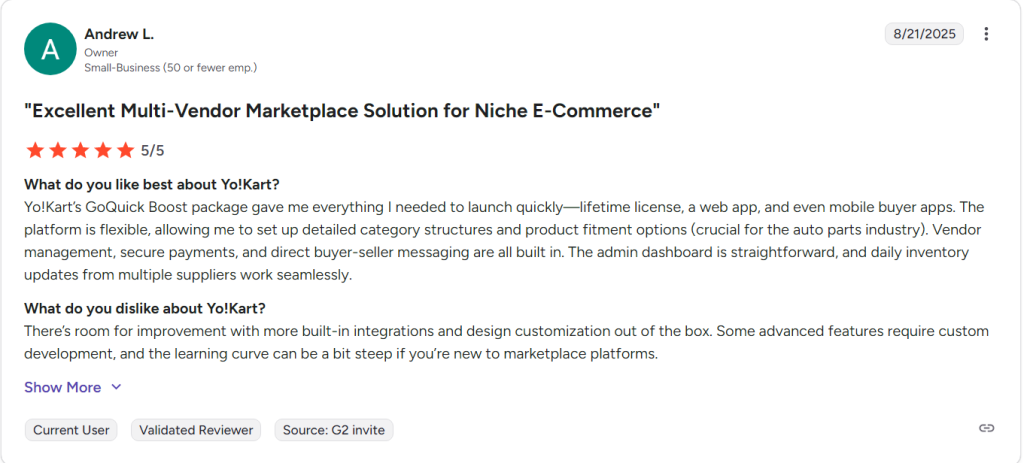
G2: Yo!Kart is an Excellent Solution to Build a Marketplace
Good Firms: Client Recommendation to Launch Marketplace with Yo!Kart
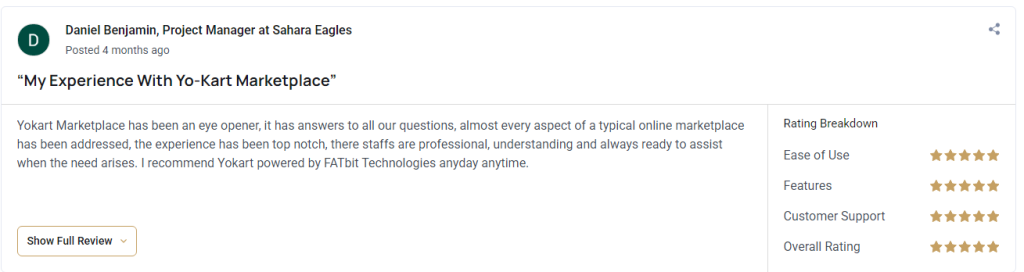
Software Suggest: Affordable Solution and Offers Out-of-the-Box features
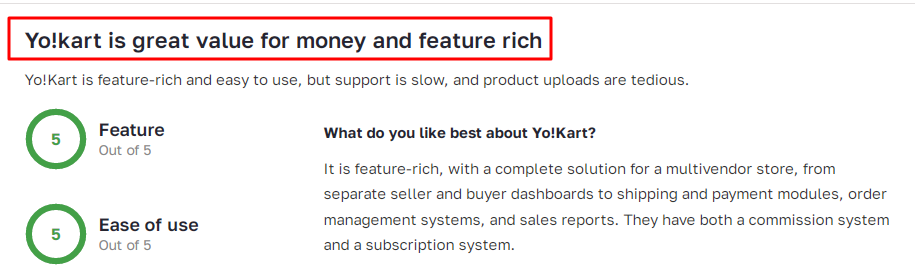
Capterra: The Client Appreciates the Customer Support and Yo!Kart’s Customization Flexibility
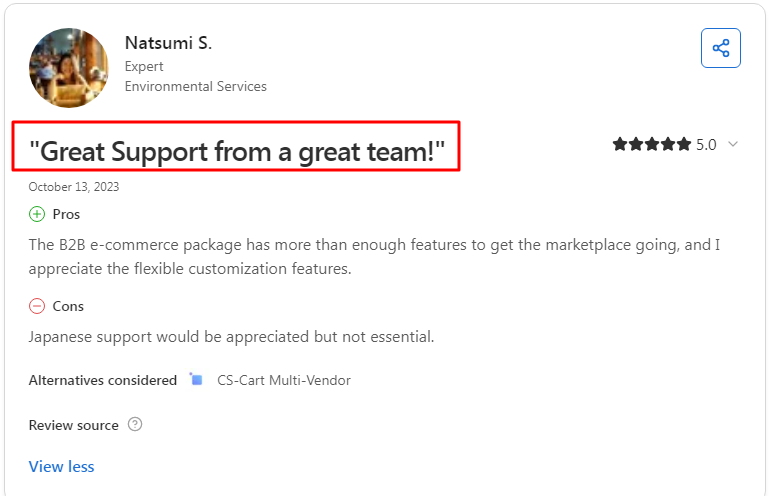
Good Firms: Flexible Solution that Supports Different Business Models
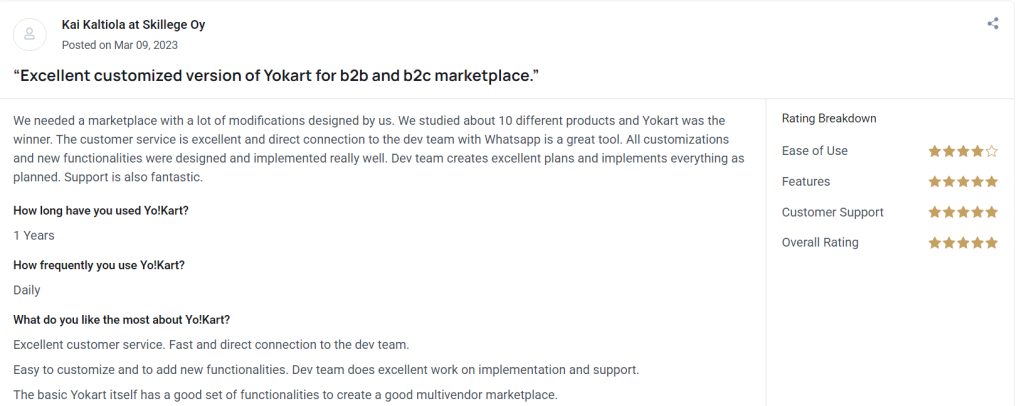
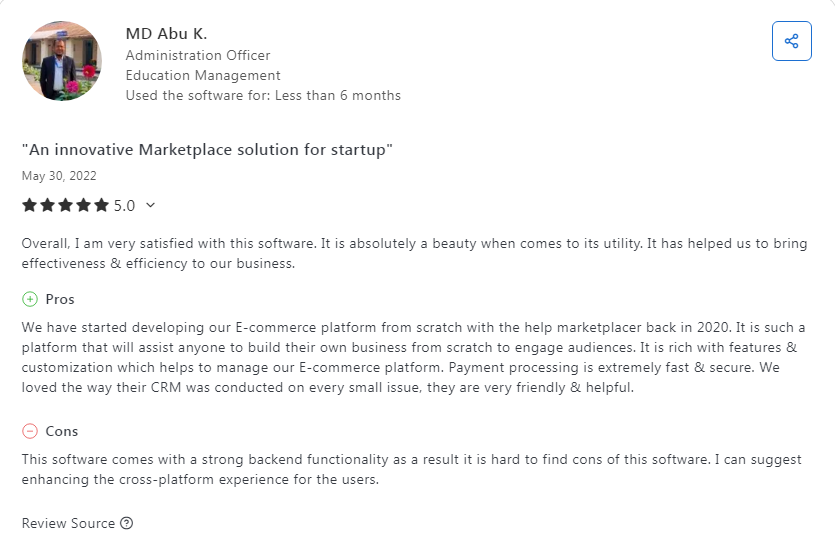
Reviews for Marketplacer (Reviews are only Available on Capterra)
Capterra: Marketplacer Helped Build eCommerce Platform
Our Recommendation
Marketplacer: Marketplacer is left behind the competition when it comes to deciding based on real-life experiences. There are multiple platforms where no ratings and reviews are available for Marketplacer. However, the solution can perform better for businesses that prefer the dropshipping model and want to integrate third-party sellers into their existing businesses.
Yo!Kart: Based on ratings and reviews on popular platforms, Yo!Kart stands out as a strong and purpose-built multi-vendor marketplace solution. The solution is praised for its customization, scalability, native mobile apps, one-time payment model and lifetime license. All these offerings of Yo!Kart makes it ideal for entrepreneurs and existing enterprise-level businesses seeking complete ownership and flexibility.
What Makes Yo!Kart a Better Marketplacer Alternative
Yo!Kart is the best eCommerce software to launch your marketplace. At the same time, it’s one of the best Marketplacer alternatives that adds more value. The solution comes with out-of-the-box features, offers a lifetime license at a one-time payment, is flexible with customization, supports growth and expansion, enables businesses to tap into the marketplace quickly and much more.
In short, Yo!Kart is not only the best Marketplacer alternative, but for all the subscription-based SaaS solutions like Shopify, BigCommerce, WooCommerce, Mirakl and others.
In addition, the software offers complete control and ownership over the platform at a similar level to that gained when building a marketplace software. Hence, Yo!Kart can also be a promising alternative to custom development.
Build a Feature-Rich Multi-Vendor Marketplace with Yo!Kart
Final Thought
In the above comparison blog, you have explored all the key factors that can help you decide on the multi-vendor marketplace software between Marketplacer and Yo!Kart. From licensing to payment models, hosting type to source code ownership, customization flexibility to the ability to support growth and rating and reviews on popular platforms, the blog helps you compare every single detail.
However, both solutions can do a miracle for your marketplace idea. You can either choose Marketplacer or get started with Yo!Kart. On the one hand, Marketplacer is a SaaS-based solution that enables enterprise-level features and functionality via a subscription model. On the other hand, Yo!Kart is a dedicated multi-vendor marketplace software that offers complete control and ownership at a one-time payment model.
According to the above key considerations and explanations, Yo!Kart is a clear winner. It offers more flexibility, control, access and ownership than Marketplacer, becoming the best Marketplacer alternative to launch a multi-vendor marketplace software.
FAQs
Q 1. What are the key benefits of choosing Yo!Kart as a Marketplacer alternative?
Ans. By getting started with Yo!Kart, you can experience several benefits. Some key benefits include:
- Yo!Kart is available at a one-time payment, but Marketplacer is not.
- It offers source code ownership which clearly means you can access the code to implement changes.
- Yo!Kart is highly customizable. You can tailor the solution as per your specific requirements.
- Yo!Kart supports growth and expansion as it’s built with scalability in mind, making it a future-proof solution.
- No hidden, recurring, or transactional charges are required.
Q 2. How is Yo!Kart different from Marketplacer?
Ans. The primary difference between Yo!Kart and Marketplacer is that Yo!Kart is self-hosted software that offers complete ownership and control with a lifetime license. On the other hand, Marketplacer is a SaaS-based solution that provides access based on the package you choose.
Q 3. Which is more cost-effective, Marketplacer or Yo!Kart?
Ans. However, Marketplacer doesn’t disclose its pricing officially and is available on quote. Yet several sources highlight that the cost to build a marketplace with Marketplacer involves a one-time implementation fee (varying with complexity and support), monthly fees, and a small percentage of transactions that take place on the platform.
On the other hand, Yo!Kart charges a one-time licensing fee starting at $499 to build a multi-vendor marketplace. Hence, there is a high chance that Yo!Kart can be a much more cost-efficient solution than Marketplacer.
Q 4.. Marketplacer and Yo!Kart, which is more flexible with customization?
Ans. When it comes to offering flexibility with customization between Marketplacer and Yo!Kart, Yo!Kart stands out as one of the most flexible solutions that is highly customizable. From its CMS level out-of-the-box customization options to its code-level accessibility for extensive customization, Yo!Kart is always a preferred choice.
Q 5. Can I build a B2B multi-vendor marketplace with Yo!Kart?
Ans. Yes, you can easily build a B2B multi-vendor marketplace with Yo!Kart. The team behind Yo!Kart has designed a dedicated B2B marketplace software, Yo!Kart B2B, specifically introduced to handle B2B (Business-to-Business) transactions. It enables out-of-the-box B2B features and functionalities, making transactions effortless and seamless.
Build a Powerful Multi-Vendor Marketplace with Yo!Kart
Get StartedPopular Posts