

Last Update: 17th Nov, 2026
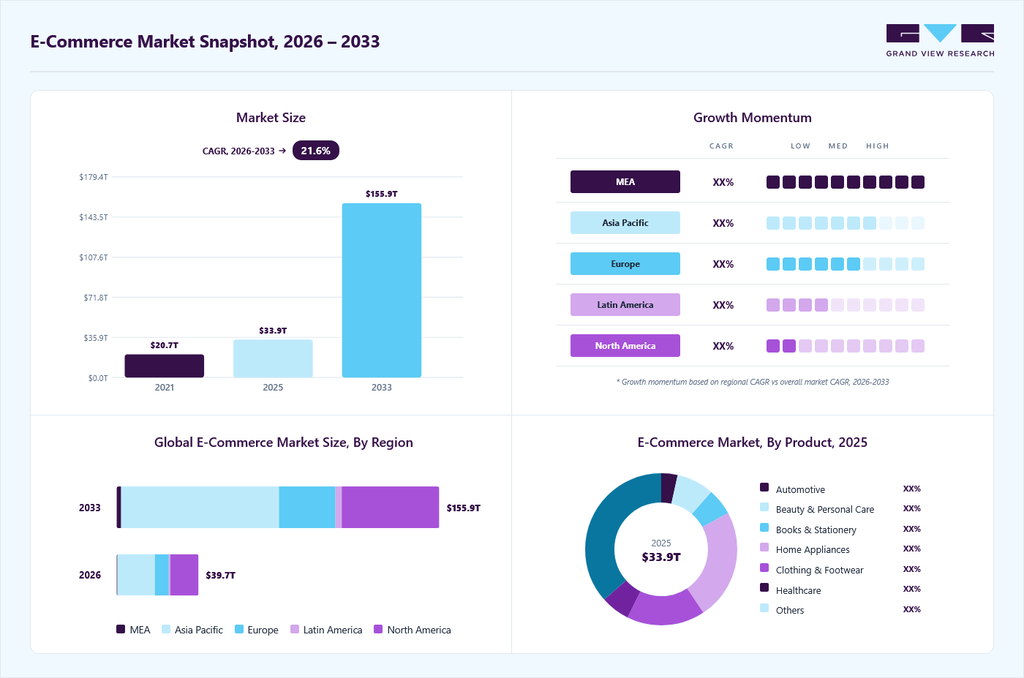
The eCommerce landscape is growing rapidly and multi-vendor marketplaces are accelerating that development. According to Grand View Research, the global eCommerce market size is estimated at $39.7 trillion in 2026 and is expected to grow at a CAGR of 21.6% from 2026 to 2033, reaching $155.9 trillion.
Moreover, the eCommerce revolution has reshaped retail interactions as well. The growth journey primarily started with B2C; B2B numbers are significantly higher and are hard to ignore. The projected growth rate suggests that the global B2B eCommerce market size will grow from $28 trillion in 2026 to $105.9 trillion by 2033, at a CAGR of 20.9%.
The number suggests that the upcoming years will be an exciting opportunity for enterprises to capitalize on the market. Established businesses, distributors, manufacturers, and large enterprises can build a multi-vendor marketplace to unlock opportunities, expand supplier networks, reach potential customers, and manage transactions through a centralized digital ecosystem.
However, the question now is how to build an enterprise multi-vendor marketplace. It is more than building a digital platform and allowing sellers to register. Businesses must consider scalability, security, vendor management, system integrations, operational workflows, and more.
This guide explains how to build an enterprise multi-vendor marketplace, the essential features to consider, the development approaches available, and how to select the right marketplace software for your business. Let’s dive in and explore.
Table Of Contents
- What Is an Enterprise Multi-Vendor Marketplace?
- How Does an Enterprise Marketplace Work?
- Types of Enterprise-Level Multi-vendor Marketplaces You Can Launch
- Essential Features of an Enterprise Multi-Vendor Marketplace
- A Quick Comparison between Traditional eCommerce Platform vs. Enterprise Marketplace
- Why Are Enterprises Investing in Multi-Vendor Marketplaces?
- Advantages of Launching a Multi-vendor Platform
- Top 8 Enterprise-Level eCommerce Marketplaces in the World
- How to Build an Enterprise Multi-Vendor Marketplace: Essential Steps
- Build Your Multi-Vendor Marketplace with Yo!Kart
- Launch an Enterprise Multi-Vendor Marketplace Platform with Yo!Kart
- Final Thought
- FAQ’s
What Is an Enterprise Multi-Vendor Marketplace?
An enterprise multi-vendor marketplace is a centralized digital platform that enables transactions between two businesses. It allows multiple independent sellers and suppliers to list and sell their products.
The platform is designed with a focus on accommodating complex business requirements, large product catalogs, high transaction volumes, multiple user roles, and integrations with existing business systems.
An enterprise-level marketplace unlocks diversified revenue streams, fuels substantial growth, and enhances the overall shopping experience.
How Does an Enterprise Marketplace Work?
An enterprise marketplace connects three primary stakeholders, including marketplace administrators, vendors, and buyers. Understanding these user types will help you explore how an enterprise-level marketplace works. You will get to know how these users serve, operate, contribute and grow an enterprise-level marketplace.
1. Marketplace administrators
The marketplace admin owns and manages the platform. They define marketplace policies, manage approvals, configure commissions, monitor transactions, and handle operations.
2. Vendors and suppliers
Vendors are the supply side. They register on the platform, create storefronts, list products, maintain inventory, process orders, and receive payments.
3. Buyers or Demand Side
Buyers on the platform are the end users. They browse product catalogs, compare products, place orders, make payments, track deliveries, and access customer support.
Types of Enterprise-Level Multi-vendor Marketplaces You Can Launch
Whether you are ordering a product online, booking a ride, or picking any online services, all possible because of the marketplaces. Some of these marketplaces are directly approaching the customers, some are to the businesses, even some of them are mediators who connect customers to customers, businesses to business, businesses to customers, and many more with their products and services.
Before you dive deep into multi-vendor marketplace platforms, let’s explore two types of enterprise-level multi-vendor marketplace with their popular examples:
- B2B (business-to-business) multi-vendor marketplace: In this marketplace model, one business offers products to others with the aim of trading with businesses in bulk orders.
Examples: Amazon Business, AliExpress, Alibaba
- B2C (business-to-customer) multi-vendor marketplace: In the B2C marketplace model, businesses directly reach their customers through the platform to sell products in retail at the customer’s preferences.
Examples: Amazon, eBay, Walmart
Essential Features of an Enterprise Multi-Vendor Marketplace
Planning to launch a multi-vendor marketplace for enterprises? Selecting the right features is critical. The platform must support the required features and ensure seamless operations. Here are the essential features to consider.
- User Management: This feature provides administrators with the ability to manage vendor registrations, buyer registrations, verification, profiles, permissions, and performance.
- Catalog Management: A catalog management system provides an efficient way to organize and maintain product information. It supports product categorization, attributes, product variations, images, descriptions, and more.
- Flexible Commission Management: Enterprise marketplaces may work with different vendors, product categories, and commercial arrangements. A flexible pricing and commission management system helps administrators configure commissions based on the applicable structure.
- Bulk Order Management: B2B procurement often involves large-volume, complex transactions. However, bulk order management support enables businesses to handle large orders, order processing, and invoice management while ensuring real-time updates.
- Advanced Analytics and Reporting: Marketplace administrators need visibility into business performance to make informed decisions. They need to know numbers and insights related to listings, orders, commissions, vendors, buyers and more. These insights help enterprises identify operational bottlenecks and opportunities for growth.
- Multi-Lingual and Multi-Currency Support: Multi-language functionality helps businesses provide a localized shopping experience, while multi-currency support allows buyers to view product prices and transact in supported currencies. These features work for enterprises planning to serve customers across multiple geographical regions.
A Quick Comparison between Traditional eCommerce Platform vs. Enterprise Marketplace
Before you build an enterprise-level multi-vendor marketplace, it’s critical to see the exact difference between an eCommerce store and an enterprise marketplace. The table below will provide you with an overview of how an enterprise marketplace requires a more comprehensive operational framework than an online store.
| Parameters | Traditional eCommerce Platform | Enterprise Multi-Vendor Marketplace |
| Sellers | Primarily one business | Multiple independent vendors |
| Product management | Centralized product management | Centralized and vendor-managed catalogs |
| Vendor management | Not generally required | Essential functionality |
| Revenue model | Direct product sales | Commissions, subscriptions, listing fees, and other models |
| Order management | Single-store order processing | Multi-vendor order allocation and processing |
| Scalability | Designed around one business | Must accommodate growing vendors, catalogs, and transactions |
| User roles | Limited administrative roles | Multiple roles and permission levels |
| Integrations | Business-specific integrations | Multiple vendor, buyer, and enterprise system integrations |
Why Are Enterprises Investing in Multi-Vendor Marketplaces?
Beyond the numbers we have discussed in the blog introduction, enterprise marketplace development offers several opportunities. In this section, you will learn why enterprises should invest in building a multi-vendor marketplace.
1. Expand Business Reach and Supplier Networks
An enterprise-level multi-vendor marketplace allows businesses to onboard multiple suppliers and sellers within a single digital ecosystem. This expands the product assortment available to buyers while giving vendors access to an established customer base. Enterprises can also expand into new geographical markets by onboarding regional suppliers and sellers.
2. Create Multiple Revenue Streams
Unlike conventional online stores that primarily earn through direct product sales, a multi-vendor marketplace can generate revenue through different business models. Enterprises can combine different revenue models according to their marketplace strategy.
These include:
- Commission on vendor transactions.
- Vendor subscription and membership fees.
- Product listing charges.
- Featured product placements.
- Third-party advertising.
- Additional value-added services.
3. Streamline Business Operations
A centralized marketplace helps enterprises manage vendors, products, orders, payments, and customer interactions through a unified platform. Moreover, automated workflows can reduce manual intervention in repetitive activities. In short, a marketplace allows enterprises to focus more on strategic activities, business expansion, and customer relationships rather than managing everyday interactions.
4. Improve Procurement and Supply Chain Efficiency
Enterprises working with multiple suppliers often need to coordinate product availability, pricing, orders, and deliveries across different channels. A centralized marketplace can simplify supplier discovery and purchasing by bringing product information and vendor offerings together. With appropriate features and integrations, enterprises can also connect marketplace operations with existing inventory, procurement, and logistics systems.
Want to Launch a Multi-Vendor Marketplace like Amazon?
Advantages of Launching a Multi-vendor Platform
A multi-vendor marketplace can benefit users in many ways. It enables customers to access a range of products at competitive pricing. It offers equal opportunity for sellers to reach a broader customer base and allows marketplace owners to generate revenue from multiple businesses, reach a global audience, and grow.
Benefits of the multi-vendor marketplace for Marketplace Owners:
1. Master Catalog: It helps the marketplace to improve customer experience by ensuring consistency across all product listings.
2. Analytics and Reporting: This marketplace feature allows marketplace owners to access reports and analytics in a few clicks and helps them make data-driven decisions.
3. Multiple Revenue Streams: A multi-vendor marketplace owner generates revenue from multiple revenue models, including listing charges, commission on each sale, promotions or advertisements, and more.
4. Automation: Marketplace software automates many tasks, including logistics, shipping, order processing, commission management, and more. It allows them to focus on marketing and marketplace growth by automating most of the tasks.
5. SEO & Marketing: Some multi-vendor marketplace platforms offer SEO tools and other marketing features, allowing marketplace owners to drive traffic and generate more revenue from the platform.
Benefits of the multi-vendor marketplace for customers:
1. Product Variety: It allows customers to browse a variety of products from multiple sellers and choose the most appropriate product.
2. Competitive Pricing: Competition between vendors reduces the price of the product which helps customers to get products at competitive pricing.
3. Enhanced Shopping Experience: Customers can compare products and prices, add to cart from multiple sellers to a single cart, and go for checkout as per convenience, or remove the product from the cart.
4. Personalized Experience: The advancement of marketplaces allows businesses to offer personalized shopping experiences to customers to increase engagement and generate more revenue.
5. Customer Support and Feedback: A multi-vendor marketplace allows customers to give feedback and raise complaints. Quick customer support and feedback help the marketplace to earn customer loyalty and improve retention.
6. Fast Shipping: Vendors process orders in a timely manner on the marketplace, allowing customers to receive the item at their convenience.
7. Return and Exchange Policy: A transparent return and exchange policy makes customers feel comfortable while shopping online. It helps the marketplace to earn customer loyalty and for customers to have a risk-free shopping experience.
Benefits of the multi-vendor marketplace for sellers:
1. Wide Customer Base: A multi-vendor marketplace has a greater audience base that allows sellers to showcase their products to a wider audience in order to increase sales and revenue.
2. Lower Expenses: A marketplace provides a complete technological infrastructure for sellers, allowing them to save money by not investing in technology and platforms.
3. Maintenance and Updates: A marketplace takes responsibility for maintenance. Sellers don’t need to pay for maintenance for store setup, store design, and any other software updates.
4. Marketing and Promotions: The pre-integrated marketing features allow sellers to promote their products to increase sales and visibility.
5. Inventory Management System: It helps sellers be notified about inventory, ensuring they maintain stock to meet customer demand for a satisfying experience with on-time delivery.
6. Order Management:- Order Management allows sellers to streamline the entire order process, from generating invoices to shipment and tracking to timely product delivery.
Top 8 Enterprise-Level eCommerce Marketplaces in the World
The eCommerce industry is booming worldwide. Every day, new eCommerce marketplaces emerge, and established marketplaces reach new heights. Let’s take a look at the top enterprise-level eCommerce marketplaces worldwide in the table below:
| Marketplaces | Founded Year & Headquarters | Founder | Industry | Revenue Model |
| Amazon | 1994 Seattle, Washington, United States | Jeff Bezos | Consumer products, services, and others | Commission, subscriptions, and web services |
| eBay | 1995 San Jose, California, United States | Pierre Omidyar | All products | 10-15% fees to seller |
| Walmart | 1962 Bentonville, Arkansas, United States | Sam Walton, Bud Walton | Consumer Staples | Referral fees, storage fees, and others |
| Alibaba | 1999 Hangzhou, China | Jack Ma, Eddie Wu, & 16 others | All products | commissions, advertising, and value-added services |
| AliExpress | 2010 Hangzhou, China | Jack Ma | Consumer products | Commission & registration fee |
| Rakuten | 1997 Setagaya City, Tokyo, Japan | Hiroshi Mikitani | eCommerce, fintech, digital content and communications | Commission, cashback, hosting fee, advertisement |
| Flipkart | 2007 Bengaluru India | Binny Bansal, Sachin Bansal | Consumer products, services, and others | Commissions, advertising, and value-added services |
| Etsy | 2005 Brooklyn, New York, United States | Chris Maguire, Rob Kalin, Jared Tarbell, Haim Schoppik | Handmade and vintage items | Commission charges from sellers |
How to Build an Enterprise Multi-Vendor Marketplace: Essential Steps
Ready to build an enterprise-level multi-vendor marketplace? Wait! It requires a structured development approach. Before selecting software or beginning development, businesses should define their marketplace objectives, operational requirements, and technology expectations. Here are the important steps to follow.
Step 1: Determine Enterprise Marketplace Requirements
The first and foremost step is to define your marketplace requirements. However, the requirements of an enterprise marketplace may differ significantly from those of a startup or small online business. Identify the operational challenges your platform needs to address and document the necessary functionality.
For example, an enterprise with an extensive supplier network may prioritize vendor management, bulk product uploads, and ERP integration. A global retail business may focus more on multi-language support, multi-currency transactions, and regional fulfillment.
You can also consider non-functional requirements such as performance, security, availability, data governance, and scalability.
Step 2: Define Business Model
Another step is to clearly define the business model. It will help you identify the functionality and technology required for your marketplace according to the target, revenue model and other specific requirements.
While defining the business model, you should identify:
- Target vendors and buyers.
- Product categories.
- Geographical markets.
- Vendor onboarding requirements.
- Pricing and commission models.
- Order fulfillment arrangements.
- Revenue generation strategies.
Step 3: Choose the Right Approach to Build an Enterprise Marketplace
Once your business and technology requirements are clear, evaluate the approaches to build your enterprise marketplace. Broadly, enterprises can choose between custom marketplace development and readymade marketplace software.
Custom development involves developing the platform from scratch according to specific business requirements. It provides greater control over architecture and implementation but generally requires more development time, technical resources, and ongoing maintenance, along with a higher initial investment.
Readymade marketplace software provides an existing foundation with essential multi-vendor functionality. By choosing the right solution, enterprises can configure and customize it according to their business requirements, potentially reducing development time and complexity.
Before you choose software, evaluate:
- Availability of essential multi-vendor features
- Customization flexibility
- Source code access
- Integration compatibility
- Platform security
- Scalability and performance
- Technical support and maintenance
- Total cost of ownership
However, the right approach depends on the level of customization required, available resources, deployment preferences, and long-term ownership goals.
Step 4: Set Up and Configure Your Platform
In case you have selected a readymade solution. Platform setup and configuration is the next step you need to follow.
Configure the platform and set up vendor registration, product management, commissions, payment methods, order workflows, and administrative permissions.
Moreover, you can also ensure integration of ERP, CRM, payment gateways, shipping providers, inventory systems, and accounting applications.
Step 5: Test Your Marketplace
Before launching your enterprise marketplace, conduct comprehensive testing to identify potential technical and operational issues. Testing should reflect realistic usage scenarios, including high traffic, large product catalogs, and simultaneous transactions.
Testing activities should include:
- Functional testing of buyer, vendor, and administrator workflows
- Performance and load testing
- Security and vulnerability testing
- Payment and transaction testing
- Integration and data synchronization testing
- Mobile responsiveness testing
- Backup and recovery testing
Step 6: Onboard Vendors and Launch Your Marketplace
Once you’re satisfied with testing and find the platform ready, the next step is to onboard vendors, publish product catalogs, configure marketplace policies, and set up other processes and go live.
However, continuous monitoring is paramount. Evaluate marketplace performance, customer experience, transaction trends, performance and issues reported by the customer. This practice helps enterprises identify and resolve issues promptly.
Looking for a Readymade Marketplace Solution?
Build Your Multi-Vendor Marketplace with Yo!Kart
Yo!Kart is a readymade enterprise marketplace solution that allows enterprises to launch their marketplace in just a few weeks. It also complies with industry-standard security measures and protects users’ data and the marketplace’s reputation. The solution supports features needed to streamline and automate marketplace operations, ensuring a seamless user experience. Available with a one-time payment model, Yo!Kart offers a lifetime license to use the software. By choosing Yo!Kart, you can establish a complete enterprise marketplace ecosystem and grow your business.
See How Yo!Kart Meets Enterprise Marketplace Requirements?
- Lifetime License: Yo!Kart doesn’t just provide temporary access to use the solution but offers a lifetime license to use the solution. You pay a license fee once and get a lifetime license.
- Data security: Data Security is the most critical concern for enterprises. By building your marketplace with Yo!Kart, you can protect the organization’s data from unauthorized access or mishandling. Yo!Kart complies with security measures, including SSL certification, PCI compliance, two-factor authentication (2FA), anti-injection, and more.
- Data migration: The ease of data migration allows enterprises to upgrade their databases, deploy new applications, take backups, restore data, or switch from one solution to another to gain a competitive advantage. Yo!Kart supports bulk data transfer.
- Fully Customizable: Customization is one of the most critical requirements for enterprise marketplaces. However, Yo!kart meets that requirement. It’s fully customizable. The solution helps enterprises to improve customer experience and streamline operations according to specific business needs.
- Easily Scalable: Yo!kart’s scalable technology infrastructure allows enterprises to adapt to evolving needs and grow the marketplace. It allows the marketplace to handle increased traffic and run smoothly despite increased load.
- Customizable Source Code: Yo!kart’s customizable source code offers complete control and access. Enterprises can implement in-depth customization by accessing the source code.
- Performance: Performance is another USP of YoKart that plays a vital role in ensuring marketplace performance. It allows the marketplace to achieve faster response times and deliver a seamless experience.
- Automation: Yo!Kart helps enterprises accelerate growth through automation. It allows businesses to improve efficiency, accuracy, and productivity by automating operations and reducing human intervention.
- Integration Compatibility: Yo!Kart allows integration with third-party essential tools and APIs. Businesses can flexibly integrate tools to enable services and features out of the box based on specific requirements.
- Advanced Reporting: Yo!Kart’s advanced reporting and analytics tools let enterprises make data-driven decisions and plan strategies accordingly.
Suggested Read: Best Marketplace Software Compared for 2027
Launch an Enterprise Multi-Vendor Marketplace Platform with Yo!Kart
Yo!Kart is a ready-to-use marketplace solution that allows entrepreneurs to launch their multi-vendor marketplace in just four steps. Let’s explore the four easy steps to launch your multi-vendor marketplace platform for enterprises:
Step 1: Package Selection
Select the package that suits your multi-vendor marketplace requirement from the different package offerings of Yo!Kart.
Step 2: Setup and Installation
After the selection of your preferred package, the Yo!Kart team will connect and help you complete the setup and installation process.
Step 3: Seller Onboarding
The next step involves onboarding sellers and promoting their products on the platform.
Step 4: Marketplace Launch
In the fourth and final step, you can launch your marketplace and start generating revenue from multiple revenue streams.
Final Thought
Launching an online multi-vendor marketplace has become an increasingly attractive venture for enterprises. At the same time, building an enterprise multi-vendor marketplace requires a clear understanding of business objectives, operational workflows, and technology requirements.
From selecting the right marketplace model to choosing the right technology, implementing customization, and ensuring scalability, every decision contributes to the platform’s success.
Talking about the marketplace foundation, businesses need to find a solution that perfectly aligns with their requirements. And Yo!kart is one of the solutions that can help you launch and operate an enterprise-level marketplace. It’s a popular readymade solution that allows enterprises to tap into their industry quickly and accelerate growth.
FAQ’s
Q 1. How Yo!Kart can help in launching an eCommerce marketplace?
Ans: Yo!Kart is a readymade eCommerce marketplace solution that helps you launch your marketplace with no hassle. It allows you to transform your idea into a flourishing marketplace and help you elevate your vision. It comes with all the essential features and functionalities to operate your platform, ensuring a seamless user experience.
Q 2. How much does it cost to develop an enterprise marketplace?
Ans: Building a marketplace from scratch can cost from $20,000 to over $2,00000. However, with Yo!Kart, you can launch your marketplace at a significantly lower initial cost compared to building from scratch.
Q 3. Is Yo!Kart a customizable marketplace solution?
Ans: Yes, Yo!Kart is a fully customizable marketplace solution that helps align your marketplace with your brand’s identity. With Yo!kart you get an opportunity to update the name, logo, color theme, and more.
Q 4. What are the security measures available with Yo!Kart?
Ans: Yo!Kart adheres to required security measures including SSL certification, PCI compliance, 2 FA, and GDPR compliance to safeguard user data and earn the trust and loyalty of the customers.
Q 5. Does Yo!Kart offer customizable source code?
Ans: Yes, Yo!Kart offers customizable source code with a lifetime license. Businesses can customize the platform, features and functionality as per their requirements by accessing the source code.
Q 6. Which integrations are essential for an enterprise marketplace?
Ans: Common enterprise marketplace integrations include ERP, CRM, payment gateways, shipping and logistics providers, inventory management systems, and accounting applications. The required integrations depend on the enterprise’s existing technology infrastructure and operational workflows.
Q 7. Is custom development necessary for building an enterprise marketplace?
Ans: Not necessarily. Custom development is not always necessary. Enterprises can use readymade marketplace software like Yo!Kart with customization capabilities to establish a marketplace without developing every component from scratch. However, custom development may be more appropriate when the business has highly specialized workflows or unique technical requirements.
Launch a Multi-Vendor Marketplace Platform for Enterprises?
Get Started NowPopular Posts