
Published date 01 Dec, 2025
The real opportunity lies in the right information. Your business can’t succeed until you understand the industry. Similarly, entrepreneurs looking to thrive in this unprecedented eCommerce landscape need to dig deeper and access all the valuable information, the secret to their marketplace success.
This highly informative craft will guide you through the numbers and statistics of the top emerging eCommerce markets, industry stats, business models you can choose from, niches you can target, competitors in specific regions, growth drivers, top eCommerce platforms across the world and much more.
However, before diving in, take an overview to see what attracts entrepreneurs to build multi-vendor marketplaces.
The eCommerce industry is evolving rapidly, and soon it will surpass the $8.91 trillion mark. Every day is like reaching new heights, setting goals and achieving them. Not only existing giants like Amazon, eBay, Alibaba, Walmart, and Etsy are the key accelerators, but emerging platforms like Temu, Target and many more recently introduced marketplaces have set examples.
For new arrivals, the journey had never been easier, especially when confronting market leaders. Yet, what were the keys to success? Their unique approaches, understanding of the market, precise targeting and more. They identified the gaps and filled them, addressed the pain point and provided the right resolutions.
Table of Contents
- Why Should Entrepreneurs and Startups Focus on Building a Multi-Vendor Marketplace?
- Benefits of Building an Online Multi-Vendor Marketplace
- Top eCommerce Platforms Reshaping the eCommerce Landscape
- What are the Different Types of Marketplace Business Models?
- Key Factors Driving Growth for the Multi-Vendor Marketplaces
- Top 5 Emerging eCommerce Markets for Multi-Vendor Startups: Countrywise Data
- Top 10 eCommerce Niches Startups Can Target When Building a Marketplace in 2026
- Challenges of Building an Online Multi-Vendor Marketplace and Their Solutions
- How Can Yo!Kart Helps You Build a Global Multi-Vendor Marketplace?
- Get Started with Yo!Kart in Just Four Easy Steps
- Conclusion
- FAQs
Why Should Entrepreneurs and Startups Focus on Building a Multi-Vendor Marketplace?
According to eMarketer, the global eCommerce sales are forecasted to reach from $6.42 trillion in 2025 to $8.91 trillion by 2030. The U.S. eCommerce sales are projected to reach $1.17 trillion in 2025. Talking about the number of online shoppers, it will surpass 3 billion by 2025.
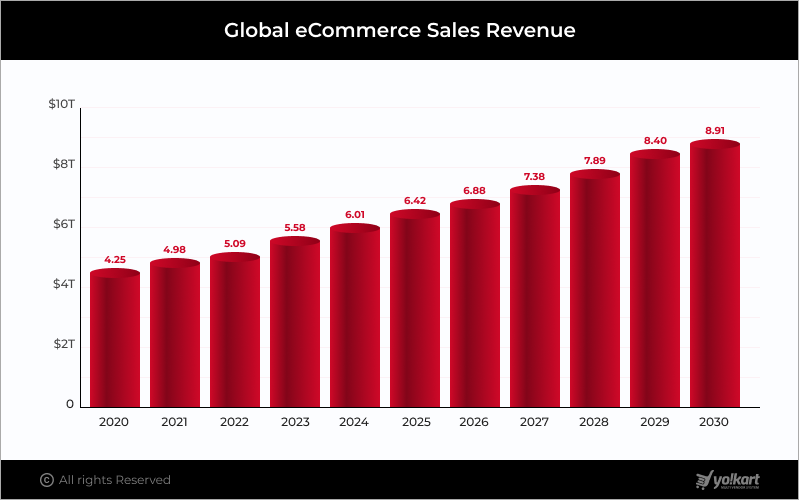
The above numbers are enough for entrepreneurs and startups to identify growth potential and decide on building an online multi-vendor marketplace.
Regardless, it doesn’t just help you generate good numbers but can bring much more beyond numbers. Let’s explore why an entrepreneur or a startup should invest in building a multi-vendor marketplace.
Benefits of Building an Online Multi-Vendor Marketplace
Lower Startup Costs
Building an online multi-vendor marketplace can be a cost-efficient venture if you are smart enough to make the right decisions. Suppose you are choosing a readymade solution to build your marketplace; it will significantly reduce the cost required to build it from scratch.
In the operational aspect, being a multi-vendor marketplace operator, you don’t need inventory. You simply need a feature-rich eCommerce platform where buyers and sellers can complete transactions seamlessly. Hence, it also saves the money required for managing inventory, order fulfillment, and more.
Moreover, building an online marketplace also eliminates the need for physical space and reduces manpower to manage operations, as it automates tasks. There are several more ways to save costs.
Global and Wider Reach
An online marketplace breaks the demographic barriers. It enables entrepreneurs and businesses to trade across the world. A marketplace can reach out to a global audience and sell products. Sellers worldwide can also list and generate revenue by selling products beyond their physical presence.
In addition, a marketplace offers a wide range of products that also allows connecting a wider audience and driving more traffic. Customers with diverse product requirements can visit and place orders through the marketplace, contributing to its wider reach.
Diverse Revenue Streams
Building a multi-vendor marketplace enables entrepreneurs to generate revenue from multiple streams, which sounds strategic and sustainable. It allows them to generate a steady income, provide more stability during economic downturns and helps mitigate risk by diversifying revenue channels.
Suppose you are operating a business and you generate revenue primarily from subscription fees. Due to some reasons, a significant percentage of platform users are not renewing their subscription plan. It can be a threat to your business, and you can experience a tough time.
In the other scenario, you are operating a multi-vendor marketplace and generating revenue from multiple streams, including commission, subscription, advertisement fees, and more. In case any of your revenue sources is underperforming, you will still be able to generate income from other sources.
Scalability
A sudden boom can shift your eCommerce business and accelerate its growth. It can increase the demand for products, sellers, buyers, and transactions.
That’s where the scalability and flexibility of your digital marketplace come in. Unlike a traditional marketplace, it helps businesses handle an increased number of listings, users, and transactions without compromising their performance, without the need for significant investment.
eCommerce businesses can expand their offerings, allowing the maximum number of users to list and register on the platform.
Top eCommerce Platforms Reshaping the eCommerce Landscape
Several marketplaces are servicing different regions and market segments. They are all acquiring customers and generating revenue through their strategies, business model and target. However, a few are recognized and popular. Let’s explore the top eCommerce marketplaces/platforms leading the industry.
| Marketplace | Founded Year | Headquarters | Region Cover | Marketplace Type | Annual Revenue |
| Amazon | 1995 | Seattle, USA | Global | B2C and B2B | $638 Billion |
| Alibaba | 1999 | Hangzhou, China | Global | B2B | $137.3 billion |
| Pinduoduo | 2015 | Shanghai, China | China | C2M | $53.9 billion |
| Etsy | 2005 | Brooklyn, New York | Global | C2C/P2P | $2.8 billion |
| eBay | 1995 | San Jose, USA | Global | B2C, B2B, C2C | $10.28 billion |
| Walmart | 1962 (Online Marketplace in 2009) | Bentonville, USA | Global | B2C, B2B | $681.0 billion (Online Sales Over $100 billion) |
| Rakuten | 1997 | Tokyo, Japan | Global | B2C, C2C and B2B | $15.04 billion |
| JD.Com | 1998 (Online in 2004 | Beijing, China | Global | B2C | $158.8 billion |
| Shein | 2008 | Singapore | Global | B2C and B2B | $37 billion |
| Wayfair | 2002 | Boston, Massachusetts | Global (Primarily in the United States) | B2C and B2B | $11.8 billion |
The marketplaces above vary significantly based on their offerings, business models, target audiences and much more. Exploring different business models and types of marketplaces can help get clarity on the marketplace you can build.
Build an eCommerce Marketplace Similar to Amazon, Etsy and eBay
What are the different types of marketplace business models?
The primary multi-vendor marketplace business models are B2B (Business-to-Business), B2C (Business-to-Consumer), and C2C (Consumer-to-Consumer). Yet, they are categorized into several categories based on their segment, target audience, offerings and more. Let’s explore different types of business models of multi-venor marketplaces:
Based Target Audience:
- B2C (Business-to-Customer): As the name suggests B2C marketplace primarily connects businesses with customers. B2C marketplaces are very common.
Examples: Amazon and eBay
- B2B (Business-to-Business): B2B marketplaces work as an intermediary between two business entities. This type of eCommerce platform allows businesses to trade in large volumes.
Examples: Alibaba and Amazon Business
- C2C (Customer-to-Customer): C2C marketplaces primarily connect two individuals with common interests in buying and selling products online. However, the marketplace is popular in second-hand product categories.
Examples: Etsy and Poshmark
Based on Offerings:
- Product-Based Marketplace: A product-based marketplace enables the buying and selling of products on the platform.
Examples: Amazon and Etsy
- Service-based Marketplace: Marketplaces built for offering services allow users to book and avail services online.
Examples: Airbnb and Uber
Based on Scope:
- Vertical Marketplace: This type of marketplace focuses on targeting customers precisely with specialized needs. A vertical marketplace can be niche-specific or can belong to a specific industry.
Examples: Etsy and Airbnb
- Horizontal Marketplace: A horizontal marketplace offers a wide range of products and services. Unlike vertical marketplaces, it targets a broader audience from different industries.
Examples: Amazon and Alibaba
Key Factors Driving Growth for the Multi-Vendor Marketplaces
The eCommerce industry is growing at a good pace. As a result, entrepreneurs and businesses operating multi-vendor marketplaces are capitalizing on this growth trend and building their digital empire.
Undoubtedly, the multi-vendor marketplaces themselves are key drivers of growth in the eCommerce industry. However, several more factors contribute to the expansion of eCommerce and its marketplaces.
- Internet Penetration Rate: A High internet penetration rate can be considered as one of the key growth drivers to eCommerce. According to Statista, the internet penetration rate as of 2025 is 73.2%. It clearly indicates that a significant percentage of people have access to the internet and can access online.
- Adoption of Online Shopping: According to several data sources, about 33% of the world’s population (2.77 billion) is shopping online. The data shows customers are increasingly adopting the online shopping trend and making purchases.
- The Rise of Mobile Commerce: The rise of mobile commerce is also one of the important forces behind eCommerce growth. According to data released by Forbes, mobile commerce sales are expected to account for 62% of all retail sales, $856 billion, by 2027.
- Integration of AI (Artificial Intelligence): Implementation of AI into eCommerce is one of the critical factors driving growth. A significant number of multi-vendor marketplaces are integrating AI for personalized recommendations, customer service and more in order to enhance the online shopping experience, which ultimately leads to more sales.
- Digital and Flexible Payment Options: The development of digital and the implementation of flexible payment options are contributing to eCommerce growth. Several marketplaces offer options such as EMI, no-cost EMI and BPNL (Buy Now Pay Later), encouraging customers to shop online. Moreover, the rise of digital payments, secure payment gateways and multiple payment methods are also facilitating seamless transactions on eCommerce platforms.
- Other Growth Factors: In addition to all the above factors, the technical advancements like AR and VR, quick eCommerce, fast and efficient delivery, omnichannel shopping, and many more are driving success to multi-vendor marketplaces and contributing to eCommerce growth.
Top 5 Emerging eCommerce Markets for Multi-Vendor Startups: Countrywise Data
Starting an eCommerce business is not just about building an online multi-vendor marketplace, but a lot more. Suppose you are an entrepreneur who is planning to dive into this highly competitive eCommerce landscape. In that case, you need a better understanding of the eCommerce market. Otherwise, you may encounter several challenges and make costly mistakes, leading to potential losses.
The section below will help you explore the top 5 emerging eCommerce markets in the world, providing valuable data and insights. By exploring these markets, you can develop a better understanding of the industry and help your business thrive.
1. United States
Data and Image Source: Mordor Intelligence
US eCommerce Market Size and Overview
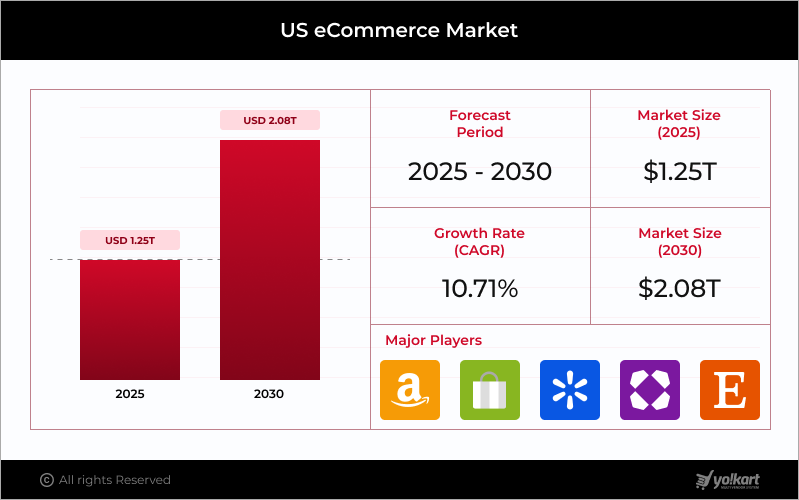
- The US is the second-largest eCommerce market in the world, after China. However, businesses tapping into its growing eCommerce landscape can experience constant growth. The eCommerce market size of the US in 2025 is recorded $1.5 trillion. However, the projection says it will reach $2.08 trillion by 2030 by growing at a CAGR of 10.71%. The expected growth rate of the US is higher than China.
Transactions Initiated by Handheld Devices (Mobile)
- Approximately 72% of eCommerce transactions in the US took place via smartphones. However, the figures show that the conversion rate of small screens is lower by 35.1% than desktops.
Preferred Payment Methods in the US
- Cards ( Visa, Mastercard, and American Express ) retain about a 54% share of online payments in the US. However, the remaining 46% transactions take place via other methods such as digital wallets, BPNL and others. Platforms like PayPal, Apple Pay and Google Pay are popular. In addition, the adoption of BPNL is the highlight, growing at a CAGR of 18.3%.
Top Niches in the US in High Demand
- Top US eCommerce niches include consumer electronics, sustainable products, health and wellness, and pet products. However, toys, DIY, fashion and fitness equipment are also high in demand.
The top 5 eCommerce Market Leaders in the US are:
- Amazon
- eBay
- Walmart
- Wayfair
- Etsy
Looking for a Fully Customizable and Scalable eCommerce Platform
2. China
Data and Image Source: Mordor Intelligence
China’s eCommerce Market Size and Overview
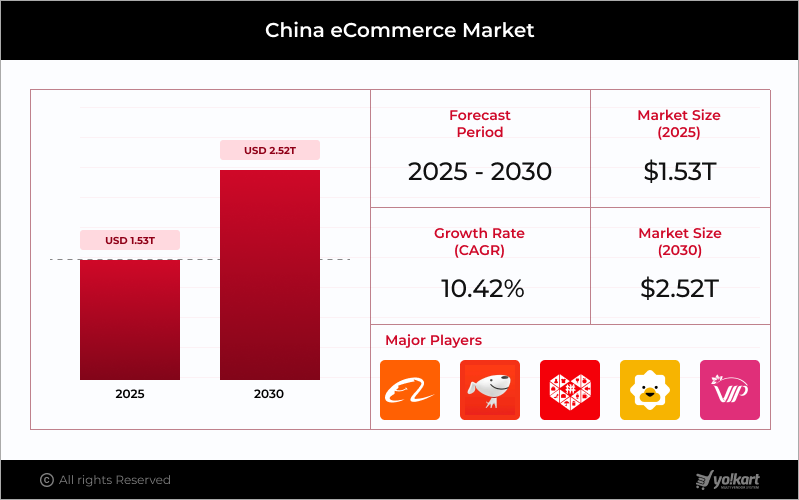
- China is the largest eCommerce market in the world. The market size is valued at $1.53 trillion in 2025 and forecasted to reach $2.52 trillion by 2030, growing at a CAGR of 10.42%. The data indicates that the country is ruling the eCommerce world.
Transactions Initiated by Handheld Devices (Mobile)
- 68% of entire eCommerce transactions in China were completed by mobile and tablets.
Preferred Payment Methods in China
- Mobile payments are leading in China. About 92% of customers initiate transactions using mobile payment options. Alipay and WeChat Pay handle a vast majority of online transactions, about 90% of total online transactions.
China’s Top Niches High in Demand
- Health and wellness, beauty and personal care, sustainable products, electronics and home decor are a few popular niches in China. Electronics alone accounted for 22% percent in 2024. However, the food and beverage market is also growing at a good rate.
The top 5 eCommerce Market Leaders in China are:
- Alibaba Group
- JD.com Inc.
- Pinduoduo Inc.
- Suning.com Co. Inc.
- Vipshop Holdings Ltd.
3. United Kingdom
Data and Image Source: Mordor Intelligence
UK eCommerce Market Size and Overview
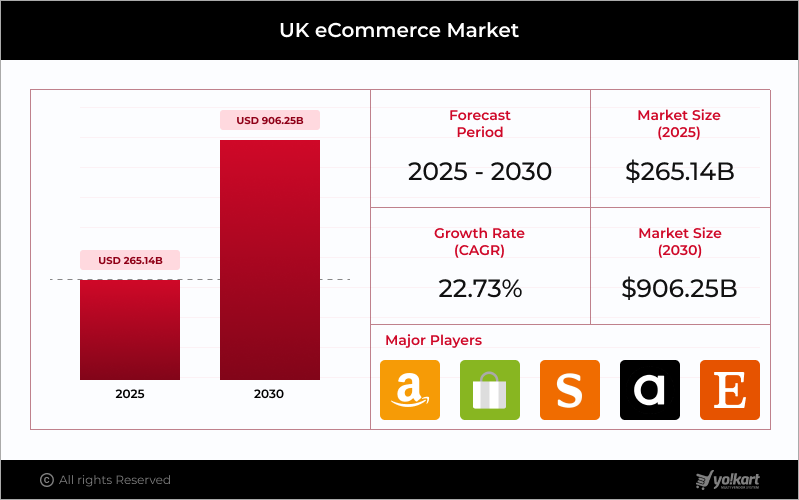
- The UK eCommerce marketplace in 2025 is estimated at $265.1 billion and is projected to reach $906.2 billion by 2030 at a CAGR of 22.73%. The UK is the third-largest eCommerce market globally after China and the US. The eCommerce penetration rate in the UK is also higher, about 30.6%. If you are an entrepreneur looking for a business opportunity, building a multi-vendor marketplace can help you achieve your goals.
Transactions Initiated by Handheld Devices (Mobile)
- Smartphones in the UK account for over 50% of its eCommerce transactions. From discovering products to checkout, mobile phones are improving the overall shopping experience.
Preferred Payment Methods in the UK
- The payment percentage initiated by cards, including credit and debit cards, is 33%, whereas digital wallets, BPNL and more lead the segment by contributing 67% of the online eCommerce transactions. Additionally, BPNL is a preferred choice for millennials and Zen Z, about 69% and 68%.
UK’s Top Niches High in Demand
- Fashion, health and beauty, electronics, fitness and sports, and sustainable products are a few most bought categories in the UK. Alone, fashion accounts for 29% of the revenue share.
The top 5 eCommerce Market Leaders in the UK are:
- Amazon
- eBay
- OnBay
- ASOS
- Etsy
4. Japan
Data and Image Source: Mordor Intelligence
Japan’s eCommerce Market Size and Overview
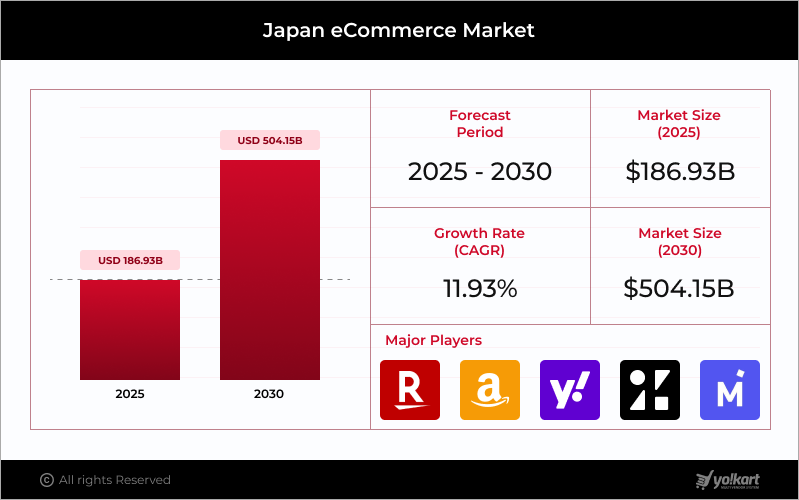
- The eCommerce market size of Japan is estimated at $186.93 billion in 2025 and is forecasted to grow at a CAGR of 11.93% to surpass $504.1 billion by 2030. For businesses seeking growth, the mobile-first strategy can be a successful driving factor in Japan. Primarily, mobile penetration, cashless payment encouragements and emerging marketplaces are key growth drivers.
Transactions Initiated by Handheld Devices (Mobile)
- Smartphones account for 65% of all online transactions initiated in 2024.
Preferred Payment Methods in Japan
- Credit and debit card payments in Japan are responsible for 68% of the digital payments and the remaining 32% belongs to digital wallets and others like BPNL. In addition, PayPay, LINE Pay, and Rakuten Pay are popular payment platforms for digital transactions.
Top Niches in Japan High in Demand
- Top eCommerce niches in Japan include fashion and beauty, food, personal care, electronics, and travel. Furniture, toys, DIY, and hobbies are also strong sectors to tap.
The top 5 eCommerce Market Leaders in Japan are:
- Rakuten
- Amazon Japan
- Yahoo!Japan Shopping
- ZOZOTOWN
- Mercari
5. Germany
Data and Image Source: Mordor Intelligence
Germany’s eCommerce Market Size and Overview
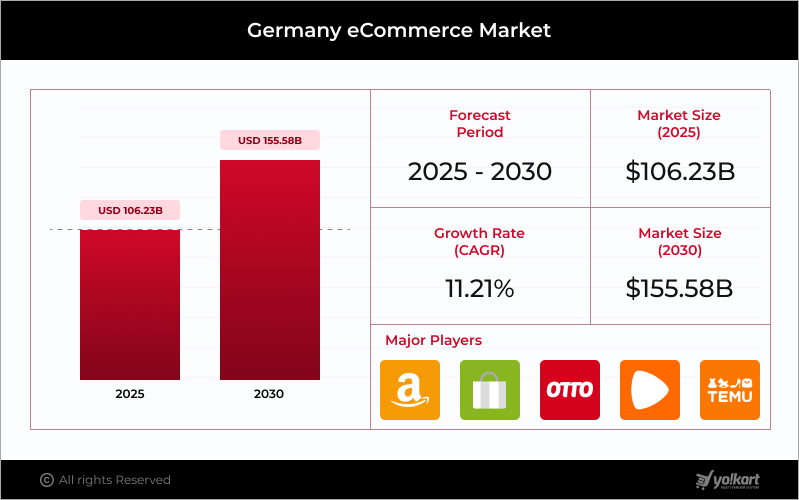
- With a 106.2 billion eCommerce market size, Germany is projected to reach $155.5 billion by 2030, growing at a CAGR of 11.21%. When discussing key growth drivers, high smartphone and internet penetration rate, the ongoing shift in consumer behavior, digitalization of businesses of all sizes and robust shipping options are at the top.
Transactions Initiated by Handheld Devices (Mobile)
- Smartphones are responsible for 63% of Germany’s eCommerce sales revenue.
Preferred Payment Methods in Germany
- A significant percentage, about 64% of payments for online bought products, are initiated through digital wallets like PayPal, according to Statista. However, purchasing on account or invoice, Klarna, and cards are also popular payment methods in Germany.
Top Niches in Germany High in Demand
- Fashion and apparel, electronics and media, and health and wellness, home goods, and eco-friendly niches or categories of high high-demand products. Businesses building marketplaces targeting customers in Germany can consider these categories.
The top 5 eCommerce Market Leaders in Germany are:
- Amazon.de
- eBay.de
- Otto.de
- Zalando.de
- Temu.com
Top 10 eCommerce Niches Startups Can Target When Building a Marketplace in 2026
Stepping into the eCommerce world by building a multi-vendor marketplace can be game-changing for startups. All they need to do is identify potential customers and meet their demands.
The best advice for startups is that instead of selling everything to everyone, focus on a specific customer segment and build a successful and profitable eCommerce business. The niches below are trending in the eCommerce space. If you are an entrepreneur or startup looking for top trending niches for 2026, let’s find the best-suited one for your marketplace.
1. Sustainable and Eco-Friendly Products
Sustainability in eCommerce is changing consumers’ shopping habits. They are focusing on buying sustainable and eco-friendly products. According to several reports, about 80% of customers are willing to pay extra for eco-friendly products. Hence, building a marketplace for sustainable and eco-friendly products can be a profitable business venture.
2. Health and Wellness
Health and Wellness is one of the leading eCommerce niches. The global market size reported in 2024 was $3.8 trillion and was also expected to grow at a CAGR of 3.51% to reach $5.27 trillion in 2033, according to Research and Markets.
Suggested Read: How to Build a Marketplace for Health Supplements
3. Electronics and Digital Products
Increasing consumer demand and the advancements of technologies have increased the demand for consumer electronics. According to Grand View Research, the global consumer electronics market size was valued at $1.2 trillion in 2024 and is projected to grow at a CAGR of 6.6% to reach $1,7trillion by 2030.
Suggested Read: Building a Digital Products Marketplace
4. Fashion and Apparel
The fashion and apparel niche in eCommerce has shown consistent growth. It’s not surprising that the niche is projected to grow at a CAGR of 9.10% during the forecasted period 2025-2034 to reach over 1.7 trillion by 2034, according to Precedence Research. The U.S. e-commerce apparel market size alone is projected to be worth approximately $415 billion.
5. Pet Care
The Pet Care eCommerce market is also growing rapidly. The market size was valued at $94.89 billion in 2024 and is expected to reach $147.59 billion by 2030, growing at a CAGR of 7.8%. Moreover, North America is the largest market for pet care and alone holds the market share of over 40% according to Grand View Research.
6. Home and Kitchen Essentials
Consumers are increasingly buying home decor items, smart appliances and tools with a desire to customize living space, improve efficiency, and improve overall living space and ease daily tasks. According to Research and Markets, the eCommerce household appliances market in 2025 has reached $88.50 billion and is projected to grow at a CAGR of 12.47% to reach $202.59 billion by 2032.
7. Beauty and Personal Care
Beauty and Personal care is another popular niche or category for startups and businesses to target. You can see several beauty brands grow at a rapid pace in recent years. The growing demand for natural, organic and exclusive products has boosted its growth. In 2025, the global eCommerce beauty and personal care market is expected to grow at a CAGR of 19.6% to reach over $1.4 trillion by 2030, according to Grand View Horizon.
8. Sports and Fitness Equipment
Due to growing health consciousness and market demand, the sports and fitness equipment sector is expanding rapidly. By building a multi-vendor marketplace for these niche businesses can capitalize on a good eCommerce market share. According to data available with Grand View Research, the global sports equipment market size is expected to reach $578.9 billion by 2030.
9. Print-on-Demand
The rising demand for customized and personalized products has attracted businesses in large numbers. Especially small businesses and suppliers making good wealth from this niche. According to Precedence Research, the global Print-on-Demand market size in 2025 is recorded at $12.96 billion and expected to surpass $102.9 billion by 2034, growing at a CAGR of 26%. On the other hand, North America is predicted to dominate the Prin-on-Demand market with a revenue share. On the other hand, the Asia Pacific market is expected to grow at a CAGR of 28%.
Suggested Read: How to Build Print on Demand Marketplace
10. Handmade and Unique Products
The growing demand for unique and handmade products is the primary growth driver for marketplaces built for handcrafted goods and items. Etsy is one of those successful marketplaces that has proven the demand for handmade and antique products. The data also demonstrates its potential. According to Grand View Research, the global dandicrafts market size was valued at $739.9 billion and is projected to reach $983.12 billion by 2030.
Want to Build a Marketplace for a Specific Niche?
Challenges of Building an Online Multi-Vendor Marketplace and Their Solutions
Undoubtedly, building an eCommerce business is an exciting and profitable venture. It can drive growth and generate steady incomes, but one can’t ignore uncertainties and unexpected challenges.
In short, eCommerce brings countless opportunities that can let your business thrive. At the same time, a few challenges you need to address and overcome. Let’s explore the challenges of building a multi-vendor marketplace and learn how to overcome them.
Challenge 1: Technology and Software Selection
The first and foremost challenge startups and entrepreneurs face is how to decide on the right technology and software. Multi-vendor marketplace requirements are complex. Hence, startups need to develop an infrastructure that can ensure seamless transition without leading to any performance-related challenges. In addition, the evolving need of a marketplace brings unexpected implementation and feature requirements. Startups again need to look for a technology that can meet evolving needs.
Solution:
What can be done to decide on the best technology and software is to find a solution that is built with reliable technology, scalable, customizable and offers complete control and access. In this way, startups can address challenges related to technology and software selection.
How can Yo!Kart help?
Yo!Kart is built on the LAMP stack (Linux, Apache, MySQL, and PHP), a reliable and trusted technology. It also leverages several other technologies to provide a robust infrastructure. The software is fully customizable and easily scalable, which enables businesses to tailor it as per their specific requirements and handles the growing demand of business without leading to any performance-related challenges.
Challenge 2: Trust and Security Related Concerns
Customers often choose to buy from eCommerce platforms they trust and that are popular. They don’t want to share their personal and financial details with a platform they don’t have an idea about. Even sellers also hesitate in listing products and sharing business details on the platform new to them. Hence, building trust is another challenge for entrepreneurs launching a multi-vendor marketplace.
Solution:
Be transparent with your policies, clearly communicate with users, including buyers and sellers, implement strong security measures, offer multiple and secure payment options, provide robust customer support and always be open to resolving queries of the marketplace users.
In addition, attract more and more users via several offers, discounts and perks, ask customers to add reviews and ratings, showcase and highlight customer responses, and try to list your marketplace on the popular platforms. Keep
How can Yo!Kart help?
Yo!Kart lets the marketplaces implement multiple-layer strong security measures, including protection against SQL injection, PCI DSS compliance for payments, 2-factor authentication, and many more, ensuring high-level security on the marketplace. It helps the marketplace operator in building trust among customers by providing options to directly connect and interact with customers, solve their queries, and tools to promote businesses and directly spread brand awareness.
Challenge 3: Quality Control
Optimum quality is another critical requirement when operating a multi-vendor marketplace. It also helps businesses improve the overall shopping experience and lets marketplaces retain traffic on the platform. If you are delivering the best, there will be a higher chance of getting referrals and returning customers.
However, quality on the multi-vendor marketplace is not just limited to product, but it extends to the quality of product listings, including images, content and others. In addition, customer support and order fulfillment are also part of standard quality parameters in terms of user experience.
Solution
To ensure quality on a multi-vendor marketplace, craft detailed guidelines, mentioning all the necessary details and quality parameters related to product listings, product quality, customer services, return and refunds policies and more. In addition, set a proper vendor onboarding process, try to onboard vendors with good market reputations, always keep an eye on customers’ feedback, ratings and suggestions. Reward vendors delivering the best and set clear consequences for vendors who continuously fail to meet quality parameters.
How can Yo!Kart help?
Yo!Kart provides all the necessary tools for the admin to ensure quality on a multi-vendor marketplace. The platform admin can approve new vendor requests by properly vetting them, manage their listings, monitor performance and evaluate, identify products not performing well and determine whether they meet quality standards, and more.
Challenge 4: User Experience on The Marketplace
Over 60% customers say that a good user experience is the primary need on the marketplace, even over price and affordability. A significant percentage of users don’t return to the platform with a bad user experience in their first interaction. Marketplace UX/UI is one of the primary reasons marketplaces experience failure in the initial days.
Solution:
Prioritize user experience over anything. Build a marketplace with an enhanced UX/UI that improves the overall user experience on the marketplace. If building a marketplace from scratch, find the right UX/UI expert who understands the industry, knows your customer and helps you build an intuitive and user-friendly platform based on your specific requirements.
How can Yo!Kart help?
Yo!Kart is a user-friendly marketplace software. It enhances the overall user experience on the marketplace. Yo!Kart has helped over 5500+ worldwide businesses build and launch their marketplaces, proving its intuitiveness and user experience.
Challenge 5: Puzzled Between Onboarding Sellers or Attracting Buyers Frist
Entrepreneurs and startups often get puzzled when they think of whom to attract first, the buyer or seller, the chicken-egg problem in a multi-vendor marketplace. If there is no seller, then how come buyers participate? On the other hand, if no buyer is there, then is it a good practice to approach sellers to list products on the platform?
Solution:
The answer to the puzzle is onboard sellers first. Before you reach out to customers, you need to fulfill demand (Supply -Vendors) on the marketplace. You need to list products so that buyers can explore and shop. The best way to attract vendors initially is to offer incentives, allow free listings, and provide value to the first few vendors. In addition, several strategies you can plan and implement.
Why attract the seller first?
Businesses can wait for customers on the marketplace. On the other hand, if there are no products listed on the marketplace, buyers will explore options. Buyers have wider options. They can explore other options. However, being a seller or a business owner, you need to wait for the customers to come. Hence, attracting sellers with some perk is practical and sounds logical.
How can Yo!Kart help?
Yo!Kart is a readymade marketplace software that enables entrepreneurs to launch a marketplace that supports all the necessary features, including features required for sellers. It provides all the tools for product management, inventory management, discount and ad management, which reduces the operational burden for sellers. Additionally, the marketplace operator also gains access to several features that help in attracting sellers.
Challenge 6: Marketing and Branding
Branding and marketing are critical requirements when operating a multi-vendor marketplace. Startups often struggle with getting brand visibility and recognition. Initially, for multi-vendor startups, it’s hard to establish a brand image, especially when competing with existing giants. One can’t achieve a desired number of traffic, customers and sales until your marketplace is recognized and popular.
Solution:
Focus on building a strong brand identity. You can plan several marketing strategies targeting your audience, run multi-channel campaigns, and execute organic and paid marketing strategies and campaigns by leveraging several tools.
How can Yo!Kart help?
Yo!Kart offers all the necessary tools and enables marketing features required for marketing and branding. You can leverage these tools, SEO and marketing-specific features to build your brand’s unique identity. You can reach out to a wider audience through organic strategies and paid marketing campaigns.
How Can Yo!Kart Helps You Build a Global Multi-Vendor Marketplace?
The journey of building an eCommerce business begins with building a digital infrastructure where buyers and sellers can interact and complete transactions. On the other hand, the marketplace operator means the admin can control and manage, and grow the platform by ensuring seamless operations.
However, for entrepreneurs and startups looking to tap into this growing eCommerce industry, choosing a readymade solution can be a smart and affordable selection. Yo!Kart is one of the best readymade multi-vendor marketplaces software that can help you build a thriving eCommerce platform at an affordable cost.
The solution has an intuitive and user-friendly UX/UI that enhances the overall experience. Its out-of-the-box features allow all the multi-vendor marketplace participants, including buyers, sellers and admins to play their respective roles effortlessly.
Moreover, by getting started with Yo!Kart, you can have complete control and access to your marketplace and data without any restrictions. Its self-hosted nature lets you host the platform on the server of your choice. In addition, Yo!Kart’s source code ownership and one-time payment model let you own the solution completely by paying once in a lifetime.
Explore Out-of-the-Box Features of Yo!Kart
Get Started with Yo!Kart in Just Four Easy Steps
Yo!Kart allows entrepreneurs and startups to build their own multi-vendor marketplace in just four easy steps. It eliminates lengthy processes and helps businesses save both time and money. Let’s learn the steps to get started with Yo!Kart:
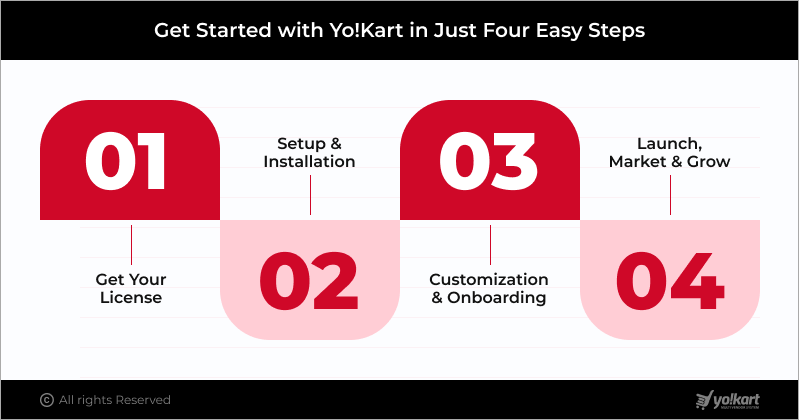
Step 1: Get a License
Choose the package that best suits your multi-vendor marketplace requirements and get your license.
Step 2: Setup and Installation
A dedicated member connects and helps you complete setup and installation.
Step 3: Customize and Onboard Sellers
The next step after setup and installation is to customize the marketplace to align your platform with your specific business requirements and targeted audience. Once done, start onboarding sellers on the platform.
Step 4: Launch, Market and Grow
In the last and final steps, launch your marketplace. However, marketing plans and growth strategies are key to success for your marketplace. Always be smart with your decisions and experience a competitive advantage.
With a strong market presence, Yo!Kart has empowered 5500+ businesses across the world by helping them build their desired multi-vendor marketplace, catering to diverse needs and specific requirements. Explore Yo!Kart’s testimonials and know what our clients say about us. Click for Testimonials
Conclusion
Building a multi-vendor marketplace is a dream of many entrepreneurs and startups. At the same time, it’s more than just building a digital infrastructure. One needs to have complete data and analytics of the eCommerce industry, including market size, leading players, key growth drivers and much more.
However, by exploring this “Emerging Ecommerce Markets for Multi-Vendor Startups in 2025,” you have gone through all the necessary details, including valuable insights and stats that you can consider while building and operating your multi-vendor marketplace. At the same time, this informative blog has also suggested a leading readymade marketplace software that can help you launch your eCommerce platform effortlessly and affordably.
FAQs
Q 1. What’s the Commerce market size of the US?
Ans. The US is the second-largest country in the world after China, with an eCommerce market size of 1.25 trillion in 2025. However, the market size is expected to grow at a CAGR of 10.71% to reach $2.08 trillion by 2030.
Q 2. What’s the name of the country with the largest eCommerce market size?
Ans. According, several reports and insights, China has the largest eCommerce market based on size and the US is the second. The eCommerce market size of China is 1.53 trillion in 2025 and is forecast to reach USD 2.52 trillion by 2030.
Q 3. What is an eCommerce platform?
Ans. eCommerce platforms are a digital space that connects buyers with sellers offering products from different niches and categories. The platform comes with all the necessary features and enables functionalities required to cater to the diversified needs of buying and selling products online.
From search and filter features for buyers to allowing sellers to list products and offering multiple payment options to automating the order fulfillment process, the eCommerce platform lets its users experience a seamless transition.
Q 4. What are the popular revenue models of multi-vendor marketplaces?
Ans. Marketplaces generate revenue from multiple revenue streams. However, primarily they generate revenue from commission charges, subscription fees, Advertising and sponsored ads.
Q 5. How much does it cost to build a multi-vendor marketplace?
Ans. The cost to build an online multi-vendor marketplace can be anywhere between $2000 – $200000, depending on your specific requirements and the business’s needs. It varies significantly. Suppose you are building a marketplace from scratch, it can cost you up to $200000 or even more. On the other hand, a readymade marketplace software like Yo!Kart enables entrepreneurs and startups to build a marketplace starting at $499.
Build a Multi-Vendor Marketplace
Get StartedPopular Posts