

Back To Home
Dedicated Developers vs Freelancers: Which is the Right Approach for Launching Your eCommerce Platform?
477
Views
Published Date: 10th Aug, 2026
TL;DR
- Dedicated developers provide exclusive project focus, structured collaboration, broader technical expertise, and long-term support, making them a stronger choice for scalable eCommerce platform development.
- Freelancers are best suited for small, short-term, or specialized tasks, while complex eCommerce projects benefit from the consistency, scalability, and accountability of dedicated development teams.
- Businesses planning feature-rich eCommerce platforms with ongoing enhancements should choose a dedicated development team that can scale alongside evolving business requirements.
- With nearly two decades of experience in eCommerce and marketplace development, FATbit Technologies offers skilled dedicated developers, agile development practices, transparent communication, and long-term technical support to help businesses build and scale future-ready digital commerce platforms.
Introduction
Launching an eCommerce platform is no longer just about building an online store. Whether you’re creating a multi-vendor marketplace like Amazon or Etsy, a B2B procurement platform, a niche marketplace, or a direct-to-consumer eCommerce website, success depends on choosing the right technology, development strategy, and, most importantly, the right development team.
One of the first decisions businesses face is whether to hire dedicated developers or work with freelance developers. While freelancers often appeal to startups and entrepreneurs because of their lower upfront costs, dedicated developers offer structured collaboration, long-term commitment, and the technical expertise needed to build scalable digital products.
The right choice ultimately depends on your project’s complexity, timeline, and long-term business goals. A freelancer may be sufficient for small-scale tasks like website updates or landing page development. However, feature-rich eCommerce platforms require expertise across frontend and backend development, UI/UX design, DevOps, quality assurance, cloud infrastructure, cybersecurity, and third-party integrations. Managing multiple independent freelancers for these functions can quickly become challenging as your platform grows.
This is why many startups, SMEs, and enterprises prefer to hire dedicated developers who work as an extension of their internal team. In this guide, we’ll compare dedicated developers and freelancers across the factors that matter most when building an eCommerce platform and help you determine the best approach for building a scalable, future-ready eCommerce platform.
Table of Contents
- Why Your Hiring Decision Matters
- Understanding Dedicated Developers
- Who Are Freelancers?
- Dedicated Developers vs Freelancers: The Core Difference
- Dedicated Developers vs Freelancers: A Detailed Comparison
- Dedicated Developers vs Freelancers: At a Glance
- When Should You Hire Dedicated Developers?
- When Are Freelancers the Better Choice?
- Cost Comparison: Dedicated Developers vs Freelancers
- Common Mistakes Businesses Make When Hiring Developers
- Why Businesses Choose FATbit Technologies to Hire Dedicated Developers
- Conclusion
- Frequently Asked Questions (FAQs)
Why Your Hiring Decision Matters
Choosing between dedicated developers and freelancers is more than a hiring decision. It directly influences your eCommerce platform’s quality, scalability, security, and long-term success.
Modern eCommerce platforms are far more sophisticated than they were a decade ago. Customers expect fast loading times, seamless checkout experiences, mobile responsiveness, personalized recommendations, secure payments, multilingual support, and integrations with logistics providers, CRMs, marketing tools, and analytics platforms.
Meeting these expectations requires expertise across multiple disciplines. A successful eCommerce project often involves:
- Business analysis and solution architecture
- UI/UX design
- Frontend and backend development
- Database design
- Payment gateway integration
- Inventory and order management
- API development
- Mobile application development
- Quality assurance and testing
- DevOps and cloud deployment
- Security and compliance
- Ongoing maintenance and feature enhancements
Overlooking any of these areas can result in delayed launches, poor user experiences, security vulnerabilities, or costly redevelopment efforts. The right hiring model ensures these responsibilities are managed efficiently, helping you build a reliable, scalable, and future-ready eCommerce platform.
Dedicated Developers: Roles, Benefits, and Business Value
Dedicated developers are software professionals assigned exclusively to your project for a specified duration. Rather than working on multiple client engagements simultaneously, they focus on your product, collaborate with your stakeholders, and align with your business objectives.
When you hire dedicated developers through an established software development company, you gain access to more than individual coding expertise. You also benefit from structured development processes, technical leadership, project management, and quality assurance practices that ensure efficient execution and consistent delivery.
Depending on your project requirements, a dedicated development team may include:
- Frontend Developers
- Backend Developers
- Full-Stack Developers
- Mobile App Developers
- UI/UX Designers
- QA Engineers
- DevOps Engineers
- Business Analysts
- Project Managers
This collaborative approach enables businesses to build complex eCommerce platforms more efficiently while maintaining consistent quality throughout the development lifecycle.
Benefits of Hiring Dedicated Developers
Hiring dedicated developers offers several advantages that extend beyond software development. They provide:
- Exclusive focus on your project
- Faster communication and decision-making
- Better understanding of your business objectives
- Higher accountability
- Scalable team structure
- Consistent coding standards
- Improved documentation
- Long-term maintenance and support
- Easier collaboration with internal teams
For businesses planning to launch scalable eCommerce platforms, these advantages often translate into faster delivery, lower project risks, and stronger long-term returns on investment.
Build Your Platform with a Dedicated Development Team
Who Are Freelancers?
Freelancers are independent professionals who offer software development services on a project, hourly, or contractual basis. Unlike dedicated developers, they often work with multiple clients simultaneously and are typically hired for short-term projects or specific technical requirements.
Common freelance platforms have made it easier than ever to connect with developers worldwide, giving businesses access to a broad talent pool across different technologies and budgets.
Freelancers are commonly hired for:
- Landing page development
- Website customization
- Bug fixes
- Plugin development
- Theme customization
- API integration
- Performance optimization
- UI improvements
- Small web applications
Many freelancers are highly skilled specialists and can deliver excellent results for focused assignments. However, since they often manage multiple projects simultaneously, availability, communication, and long-term continuity may vary.
For businesses building complex eCommerce ecosystems that require coordinated efforts across several disciplines, relying solely on individual freelancers may introduce additional management responsibilities. In such cases, a dedicated development team often provides a more structured and scalable approach.
Dedicated Developers vs Freelancers: The Core Difference
Although both dedicated developers and freelancers write code, the way they contribute to your project differs significantly. The way they collaborate, manage reponsibilities, and contribute to long-term product development differs significantly. Understanding these differences can help you choose the right hiring model based on your project’s complexity, growth plans, and business objectives.
Dedicated developers
Dedicated developers become an extension of your in-house team. They:
- Work exclusively on your project throughout the engagement.
- Align with your product roadmap and long-term business goals.
- Participate in sprint planning, team discussions, and regular progress reviews.
- Collaborate closely with designers, QA engineers, project managers, and other stakeholders.
- Provide continuous support for feature enhancements, maintenance, and platform scaling.
Freelancers
Freelancers are best suited for well-defined, short-term assignments. They typically:
- Work with multiple clients simultaneously.
- Focus on completing specific tasks or project deliverables.
- Offer flexibility for one-time or specialized development requirements.
- Move on to other projects once the assigned work is completed.
- Require additional coordination when multiple freelancers are involved in a single project.
This distinction becomes especially important when building eCommerce platforms, where continuous development, feature enhancements, integrations, and post-launch support are essential for sustained growth.
In the next section, we’ll compare dedicated developers and freelancers across the factors that matter most, including cost, scalability, communication, security, project management, quality assurance, development speed, and long-term return on investment, to help you determine the best hiring model for your business.
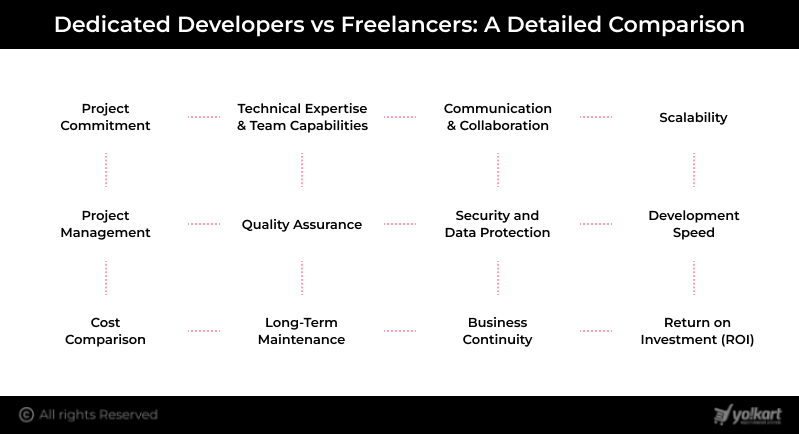
Dedicated Developers vs Freelancers: A Detailed Comparison
Choosing the right hiring model isn’t simply about comparing hourly rates. It involves evaluating how each option impacts your project’s timeline, scalability, code quality, collaboration, and long-term business goals. For an eCommerce platform, the development team you choose today will directly influence your ability to scale and innovate tomorrow.
Let’s compare dedicated developers and freelancers across the most important factors.
1. Project Commitment
Project commitment is one of the biggest differentiators between dedicated developers and freelancers.
A dedicated developer works exclusively on your project throughout the engagement. They become familiar with your business model, understand your product roadmap, and align with your company’s objectives. Since they are focused on your project, they can respond quickly to changes and actively contribute to long-term planning.
A freelancer, however, often manages multiple clients simultaneously. While many freelancers are reliable professionals, their availability can fluctuate depending on their workload. This may result in slower turnaround times or scheduling conflicts during critical project phases.
Why Dedicated Developers Win:
Their exclusive focus ensures greater accountability, consistency, and long-term alignment with your business goals.
2. Technical Expertise and Team Capabilities
Building a modern eCommerce platform requires expertise across multiple technologies, including frontend frameworks, backend development, cloud infrastructure, databases, payment gateways, security, and third-party integrations.
When you hire dedicated developers through an experienced software development company, you gain access to a multidisciplinary team that may include:
- Frontend Developers
- Backend Developers
- Full-Stack Developers
- Mobile App Developers
- UI/UX Designers
- QA Engineers
- DevOps Specialists
- Business Analysts
- Project Managers
Freelancers, on the other hand, typically specialize in one or two areas. If your project requires additional expertise, you’ll need to hire and coordinate multiple independent professionals.
Why Dedicated Developers Win: A collaborative team with diverse expertise enables faster development, better coordination, and more efficient project execution.
Assemble Your Dedicated Development Team With the Right Skill Set
3. Communication and Collaboration
Effective communication is essential for software projects, especially when requirements evolve.
Dedicated developers typically follow structured communication processes using tools like Jira, Slack, Microsoft Teams, ClickUp, or Trello. Regular sprint meetings, progress reports, and collaborative planning ensure transparency throughout the development lifecycle.
Freelancers often communicate directly with clients via email or messaging platforms. While this works well for smaller projects, managing communication across multiple freelancers can become challenging as project complexity increases.
Why Dedicated Developers Win:
Structured collaboration promotes transparency, faster decision-making, and smoother project execution.
4. Scalability
As your eCommerce business grows, so do your development requirements. What starts as a basic online store may eventually require:
- Mobile applications
- AI-powered product recommendations
- Multi-language support
- Multi-currency functionality
- Vendor management
- Subscription modules
- Advanced analytics
- ERP integrations
With a dedicated development team, scaling resources is straightforward. Additional developers or specialists can be assigned as your project grows.
In contrast, scaling with freelancers often involves restarting the hiring process, onboarding new resources, and managing multiple independent contracts.
Why Dedicated Developers Win:
They provide the flexibility to scale development resources efficiently as your business evolves, making them the better choice for long-term growth.
5. Project Management
Successful software development requires much more than writing code. It involves effective planning, coordination, and execution to keep the project on schedule and aligned with business objectives. Key project management activities include:
- Sprint planning
- Requirement analysis
- Timeline management
- Risk assessment
- Documentation
- Resource allocation
- Client communication
Dedicated development companies usually assign a project manager who oversees the entire development process and ensures timely delivery.
Freelancers, on the other hand, generally manage their own work, leaving clients responsible for coordinating multiple resources, tracking progress, and resolving dependencies.
Why Dedicated Developers Win:
Professional project management reduces administrative overhead, improves collaboration, and keeps development on track.
6. Quality Assurance
Delivering a seamless eCommerce experience requires rigorous testing across devices, browsers, and operating systems before launch.
Professional development companies follow structured QA processes, including:
- Functional Testing
- Performance Testing
- Security Testing
- Regression Testing
- Cross-browser Testing
- Mobile Responsiveness Testing
- User Acceptance Testing (UAT)
Freelancers often test their own code, which may not provide the same level of quality assurance as a dedicated QA team working through established testing workflows.
Why Dedicated Developers Win:
A structured QA process helps identify issues early, resulting in more reliable, stable, and high-performing software.
7. Security and Data Protection
Security is critical for eCommerce platforms that process customer information, payment details, and other sensitive business data.
Dedicated development companies typically follow best practices such as:
- Secure coding standards
- Non-Disclosure Agreements (NDAs)
- Role-based access controls
- Version control policies
- Regular code reviews
- Data protection measures
- Compliance with industry standards
While experienced freelancers can also implement secure development practices, security standards and processes often vary between individuals.
Why Dedicated Developers Win:
Consistent security protocols and standardized development practices help protect business-critical applications from potential risks and vulnerabilities.
8. Development Speed
Launching your platform quickly can provide a competitive advantage. Dedicated teams work collaboratively, allowing designers, developers, testers, and DevOps engineers to perform parallel tasks. This coordinated workflow accelerates development and reduces bottlenecks.
Freelancers generally work independently, making it more challenging to execute multiple workstreams simultaneously, particularly on complex projects that require cross-functional expertise.
Why Dedicated Developers Win:
Collaborative workflows and specialized teams enable faster development, quicker iterations, and a more efficient path to launch.
9. Cost Comparison
Many entrepreneurs assume freelancers are always the most cost-effective option because of their lower hourly rates. However, the true cost of software development extends beyond initial pricing. Factors such as project coordination, communication, scalability, and long-term maintenance significantly influence the overall investment.
Hidden Costs of Hiring Freelancers
While freelancers may reduce upfront expenses, businesses often incur additional costs through:
- Time spent searching and interviewing candidates
- Managing multiple contracts
- Project coordination
- Communication delays
- Rework due to inconsistent coding standards
- Lack of documentation
- Replacing unavailable freelancers
- Additional testing and bug fixing
Advantages of Hiring Dedicated Developers
Although the monthly investment may require a higher initial investment, they deliver greater long-term value through:
- Predictable pricing and resource planning
- Faster development cycles
- Better project management
- Improved code quality
- Lower long-term maintenance costs
- Reduced operational risks
Why Dedicated Developers Win:
Freelancers may be a practical choice for one-time or small-scale projects. However, for long-term eCommerce development, dedicated developers typically offer better value, lower ownership costs, and a stronger return on investment.
10. Long-Term Maintenance
Launching your platform is only the beginning. To remain competitive, your platform will require continuous improvements and technical support after deployment.
Typical post-launch activities include:
- Feature enhancements
- Security updates
- Performance optimization
- Bug fixes
- API upgrades
- Cloud infrastructure support
- Ongoing technical assistance
Dedicated developers already understand your codebase, allowing them to implement updates, resolve issues, and roll out new features more efficiently.
Freelancers may not always be available months after project completion, requiring businesses to onboard new developers who must first understand the existing code.
Why Dedicated Developers Win:
Long-term familiarity with your platform ensures faster enhancements, smoother maintenance, and continuous product evolution.
11. Business Continuity
Software development projects often encounter unexpected challenges, making continuity essential for maintaining delivery timelines.
Dedicated development companies minimize this risk through structured documentation, standardized workflows, and resource backup. If necessary, another developer can step in with minimal impact on project progress.
Why Dedicated Developers Win:
Well-defined processes and resource continuity reduce project risks and ensure uninterrupted development.
12. Return on Investment (ROI)
Choosing the right hiring model is about maximizing long-term business value rather than minimizing short-term costs.
Dedicated developers contribute to a higher return on investment by delivering:
- Faster delivery
- Higher-quality code
- Better scalability
- Reduced technical debt
- Structured documentation
- Reliable post-launch support
- Stronger collaboration
- Lower long-term maintenance costs
Freelancers can be an excellent choice for isolated or short-term assignments. However, businesses developing scalable eCommerce platforms often achieve greater operational efficiency and long-term value with dedicated development teams.
Why Dedicated Developers Win:
Their structured approach, technical expertise, and long-term commitment help businesses reduce development risks while maximizing ROI over the entire product lifecycle. For businesses launching an eCommerce platform with long-term growth plans, hiring dedicated developers generally delivers a higher return on investment.
Dedicated Developers vs Freelancers: At a Glance
Building an eCommerce platform is a long-term investment, and so is the team behind it. While freelancers can help you move quickly on individual tasks, dedicated developers provide the stability and cross-functional expertise needed to build, launch, and continuously improve a digital commerce platform.
Here’s how both hiring models compare across the factors that influence project success:
| Comparison Factor | Dedicated Developers | Freelancers |
| Project Commitment | 5/5 | 3/5 |
| Communication | 5/5 | 3/5 |
| Scalability | 5/5 | 2/5 |
| Project Management | 5/5 | 2/5 |
| Development Speed | 5/5 | 3/5 |
| Technical Expertise | 5/5 | 4/5 |
| Quality Assurance | 5/5 | 2/5 |
| Security | 5/5 | 3/5 |
| Long-Term Support | 5/5 | 2/5 |
| Business Continuity | 5/5 | 2/5 |
| Cost for Small Projects | 3/5 | 5/5 |
| ROI for Large Projects | 5/5 | 3/5 |
Key Takeaways:
- Dedicated developers are ideal for scalable, long-term commerce projects while freelancers are suited for small, short-term, or specialized tasks.
- Dedicated teams excel in collaboration, quality, security, and scalability.
- Lower upfront costs do not always translate to better long-term value.
Looking for the Right Team to Build Your eCommerce Platform?
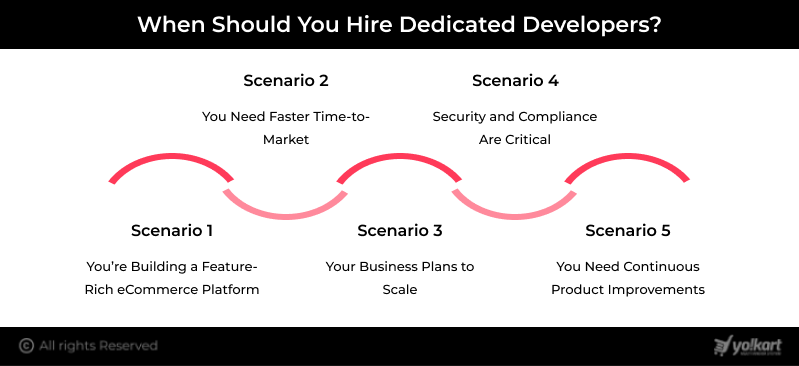
When Should You Hire Dedicated Developers?
There is no one-size-fits-all approach to software development. While freelancers are suitable for certain short-term assignments, businesses planning to launch, scale, or maintain an eCommerce platform often benefit more from hiring dedicated developers. Moreover, the right hiring model depends on your business goals, technical requirements, project complexity, and growth plans.
Let’s explore the scenarios where hiring dedicated developers is the smarter investment.
Scenario 1: You’re Building a Feature-Rich eCommerce Platform
Modern eCommerce platforms are much more than online storefronts. Customers expect seamless shopping experiences backed by advanced functionality.
A successful platform may include:
- Multi-vendor management
- Product catalog management
- Smart search and filters
- AI-powered recommendations
- Secure payment gateways
- Order and inventory management
- Shipping integrations
- Customer dashboards
- Reviews and ratings
- Mobile applications
- Marketing automation
- Analytics and reporting
Building these interconnected features requires collaboration across multiple technologies and disciplines.
A dedicated development team brings together specialists who can manage every stage of development, from solution architecture and UI/UX design to deployment and long-term support.
Scenario 2: You Need Faster Time-to-Market
Launching your platform quickly can help you capitalize on market opportunities and gain a competitive advantage.
Dedicated development teams work collaboratively, allowing designers, developers, QA engineers, and DevOps specialists to execute tasks in parallel. This streamlined workflow accelerates development without compromising quality.
Freelancers typically work independently, making it more difficult to execute multiple workstreams simultaneously.
Note: If speed is a business priority, dedicated developers are often the better choice.
Scenario 3: Your Business Plans to Scale
Many entrepreneurs launch with a Minimum Viable Product (MVP) and expand as customer demand grows. Future enhancements may include:
- Native mobile apps
- Loyalty programs
- Subscription models
- International payments
- Multiple currencies
- Multiple languages
- Vendor analytics
- AI-driven personalization
- Enterprise integrations
A dedicated development team can scale alongside your business without disrupting ongoing development. This flexibility allows you to add developers or specialists as new requirements emerge.
Scenario 4: Security and Compliance Are Critical
Trust is one of the most valuable assets for an eCommerce business. Customers expect their personal information and payment details to remain secure.
Professional development teams typically implement:
- Secure coding standards
- Data encryption
- Role-based access control
- Secure authentication
- API security
- Regular code reviews
- Vulnerability testing
- Compliance with industry best practices
This structured approach helps reduce security risks and strengthens customer trust.
Note: Hiring dedicated developers provides greater confidence in maintaining high security standards.
Scenario 5: You Need Continuous Product Improvements
Launching your platform is only the beginning. Successful eCommerce businesses continuously improve their products based on customer feedback and market trends.
Typical post-launch activities include:
- New feature development
- UI/UX improvements
- Performance optimization
- Security updates
- Third-party integrations
- Bug fixes
- Marketing enhancements
Since dedicated developers already understand your platform architecture and business goals, they can deliver updates faster and support continuous product evolution more efficiently.
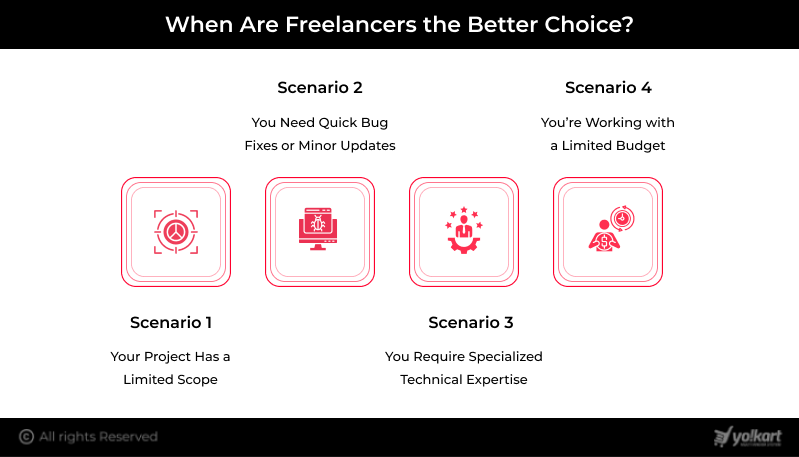
When Are Freelancers the Better Choice?
Although dedicated developers are often the preferred choice for large-scale and long-term eCommerce projects. However, freelancers can be a practical and cost-effective option for businesses with limited requirements, short timelines, or niche technical needs.
Here are the scenarios where hiring a freelancer might be the right decision:
Scenario 1: Your Project Has a Limited Scope
Freelancers are well-suited for projects with clearly defined requirements that can be completed independently.
Examples include:
- Landing page development
- Website redesign
- Logo creation
- Banner design
- Minor UI improvements
- Small plugin development
Scenario 2: You Need Quick Bug Fixes or Minor Updates
When you need to resolve a specific issue without ongoing development support, hiring a freelancer can be both efficient and economical.
Examples include:
- Fixing checkout errors
- Payment gateway issues
- CSS improvements
- Database optimization
- Performance enhancements
Scenario 3: You Require Specialized Technical Expertise
Some projects require niche skills that aren’t needed on a long-term basis. In such cases, hiring a freelancer with specialized expertise can be a smart choice.
Examples include:
- Shopify customization
- Magento extension development
- WordPress optimization
- AI model integration
- Blockchain implementation
Scenario 4: You’re Working with a Limited Budget
Early-stage startups with limited funding may initially choose freelancers to validate their business ideas before investing in a larger development team.
As the product gains traction and development needs become more complex, transitioning to a dedicated development team can provide the scalability, collaboration, and long-term support needed for sustainable growth.
Cost Comparison: Dedicated Developers vs Freelancers
Cost is often the deciding factor when choosing between dedicated developers and freelancers. However, focusing solely on hourly rates can be misleading. To make an informed decision, businesses should evaluate the total cost of ownership (TCO), including recruitment efforts, project management, quality assurance, scalability, and long-term maintenance.
| Cost Factor | Dedicated Developers | Freelancers |
| Hourly Cost | Moderate | Lower |
| Monthly Cost | Predictable | Varies |
| Recruitment Effort | Minimal | High |
| Project Management | Included | Usually Client Managed |
| Quality Assurance | Included | Additional Cost |
| Team Collaboration | Included | Separate Hiring Required |
| Long-Term Support | Included | Depends on Availability |
| Scalability | Easy | Difficult |
Hidden Costs of Hiring Freelancers
While freelancers often have lower upfront rates, businesses should also account for the indirect costs that can impact project timelines and budgets, including:
- Time spent recruiting and interviewing
- Managing multiple freelancers
- Communication delays
- Rework due to inconsistent coding practices
- Knowledge transfer when freelancers leave
- Lack of documentation
- Extended testing cycles
- Project delays
These indirect costs can significantly increase the overall investment required to build and maintain an eCommerce platform.
Why Dedicated Developers Deliver Better Value
Hiring dedicated developers through an established software development company provides access to a complete development ecosystem rather than individual contributors.
Benefits include:
- Experienced professionals
- Structured workflows
- Agile methodologies
- Dedicated project management
- Quality assurance
- Ongoing maintenance
- Faster issue resolution
- Better collaboration
Although the initial investment may be higher, dedicated development teams often reduce operational overhead, accelerate delivery, and deliver a stronger return on investment for long-term eCommerce projects.
Build Smarter with Predictable Development Costs
Common Mistakes Businesses Make When Hiring Developers
Hiring the right development team is a critical step in building a successful eCommerce platform. Choosing the wrong partner can lead to missed deadlines, budget overruns, technical debt, and costly rework. Avoid these common mistakes to set your project up for long-term success.
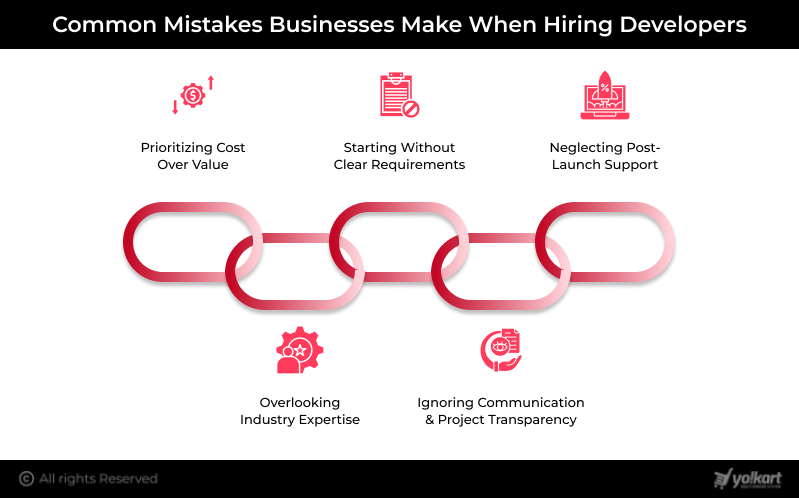
Mistake 1: Prioritizing Cost Over Value
Choosing the lowest-cost option may reduce upfront expenses, but it doesn’t always deliver the best long-term results.
Instead of comparing hourly rates alone, evaluate a developer’s technical expertise, communication practices, industry experience, scalability, and post-launch support. A strategic technology partner often delivers greater value over the life of your project.
Mistake 2: Overlooking Industry Expertise
Building an eCommerce platform requires more than technical skills. Developers should understand the unique workflows and challenges of digital commerce, including:
- Marketplace workflows
- Payment gateways
- Inventory management
- Customer journeys
- Security best practices
- Performance optimization
- Choosing developers with relevant industry experience reduces development risks and accelerates project delivery.
Mistake 3: Starting Without Clear Requirements
Well-defined project requirements are the foundation of successful software development. Before hiring a development team, clearly outline your:
- Business objectives
- Core features
- User roles
- Integrations
- Timeline
- Budget
- Success metrics
Clear documentation improves collaboration and minimizes misunderstandings.
Mistake 4: Ignoring Communication and Project Transparency
Consistent communication is essential for keeping projects on track and resolving issues quickly.
Before finalizing a development partner, ask questions such as:
- How often will progress be shared?
- Which communication tools are used?
- Who will be your primary point of contact?
- How are project risks managed?
Transparent communication is essential for successful software development.
Mistake 5: Neglecting Post-Launch Support
Software requires ongoing maintenance. It keeps your eCommerce business secure, competitive, and high-performing.
Ensure your development partner can provide:
- Feature enhancements
- Security updates
- Bug fixes
- Performance optimization
- Technical support
Choosing a partner that provides reliable post-launch support protects your investment and enables your platform to grow with your business.
Why Businesses Choose FATbit Technologies to Hire Dedicated Developers
Hiring the right development partner can have a lasting impact on your project’s success. While many companies offer dedicated development services, businesses should look beyond pricing and evaluate factors such as technical expertise, industry experience, development processes, communication, scalability, and long-term support.
With more than 20 years of industry experience, FATbit Technologies has helped startups, SMEs, and enterprises transform their ideas into successful digital businesses. From eCommerce platforms and online marketplaces to rental, EdTech, healthcare, and other custom software solutions, FATbit combines deep domain expertise with a structured development approach to accelerate digital transformation.
Whether you’re launching a new digital platform or expanding an existing one, FATbit’s developers work as an extension of your in-house team, ensuring faster execution, transparent collaboration, and solutions aligned with your business goals.
1. Extensive Experience in eCommerce & Marketplace Development
Unlike general software development agencies, FATbit Technologies has deep expertise in building digital commerce solutions across multiple industries.
The team has successfully delivered projects for:
- Multi-vendor marketplaces
- B2B eCommerce platforms
- Service marketplaces
- Rental marketplaces
- Digital products marketplaces
- Online tutoring platforms
- Healthcare marketplaces
- Hyperlocal delivery platforms
- Food ordering platforms
This extensive domain expertise enables faster development, minimizes implementation risks, and ensures every solution follows proven industry best practices.
2. Access to a Skilled Development Team
FATbit gives businesses access to a carefully selected pool of experienced developers with expertise across modern technologies and frameworks.
The company offers dedicated:
- PHP Developers
- Laravel Developers
- React Developers
- Angular Developers
- Node.js Developers
- Flutter Developers
- React Native Developers
- Python Developers
- UI/UX Designers
- QA Engineers
- DevOps Engineers
- AI & Machine Learning Specialists
Instead of spending months recruiting, businesses can quickly onboard developers with the right technical expertise and begin development with confidence.
3. Flexible Hiring Models
Every business has unique technical and business requirements. To accommodate varying budgets and development needs, FATbit offers multiple engagement models, including:
- Dedicated Team
- Fixed Price
- Hourly Engagement
Whether you need an individual developer or a cross-functional development team, these flexible models allow you to scale resources as your project evolves.
4. Agile Development Methodology
FATbit Technologies follows agile software development practices to ensure transparency, collaboration, and continuous improvement throughout the project lifecycle.
Clients benefit from:
- Sprint planning
- Regular progress updates
- Milestone-based delivery
- Transparent communication
- Faster feedback cycles
- Continuous quality improvements
This iterative approach helps reduce development risks, adapt to changing requirements, and accelerate time-to-market.
5. Focus on Quality, Reliability, and Security
Every project follows established engineering standards and quality assurance practices to deliver secure, scalable, and high-performing software.
The development process includes:
- Code reviews
- Manual and automated testing
- Security testing
- Performance optimization
- Cross-browser compatibility testing
- Mobile responsiveness testing
By integrating quality assurance throughout the development lifecycle, the team helps businesses launch reliable and secure digital products.
6. Transparent Communication & Quick Onboarding
FATbit emphasizes clear communication and a streamlined onboarding process to help businesses start development without unnecessary delays.
Clients benefit from:
- Dedicated project managers
- Weekly progress reports
- Sprint reviews
- Collaboration tools such as Jira, Slack, Microsoft Teams, and ClickUp
- Regular feedback sessions
This structured workflow ensures complete transparency and keeps projects moving efficiently from planning to deployment.
7. Long-Term Technology Partner
Software development doesn’t end with deployment. FATbit Technologies provides continuous support to help businesses enhance, maintain, and scale their products.
Post-launch services include:
- Feature enhancements
- Platform upgrades
- Performance optimization
- Security updates
- Bug fixes
- Third-party integrations
- Technical maintenance
By combining experienced developers, proven development processes, and long-term technical support, FATbit enables businesses to build digital products that are ready to scale and evolve with changing market demands.
Partner with Experienced Development Professionals
Conclusion
Choosing between dedicated developers and freelancers goes beyond comparing costs. It is about selecting a hiring model that aligns with your project requirements, business goals, and long-term growth strategy.
Freelancers remain an excellent choice for short-term assignments, minor enhancements, and specialized tasks where flexibility and lower upfront costs are priorities. However, if your goal is to launch a scalable eCommerce platform capable of supporting long-term growth, hiring dedicated developers is the more strategic investment.
Hiring dedicated teams provides consistent collaboration, broader technical expertise, structured project management, stronger security, and ongoing support. These advantages help reduce development risks, accelerate delivery, and create a solid foundation for sustainable business growth.
These benefits become even more significant when you partner with an experienced technology company. With deep expertise in eCommerce and marketplace development, FATbit Technologies empowers businesses to transform ideas into robust, high-performing digital platforms through its dedicated developer hiring services.
Frequently Asked Questions (FAQs)
1. What is a dedicated developer?
A dedicated developer is a software professional assigned exclusively to your project for a defined period. They work closely with your team, understand your business goals, follow your development processes, and contribute consistently throughout development and post-launch support.
2. Is it better to hire dedicated developers or freelancers?
The answer depends on your project requirements. Freelancers are suitable for short-term or well-defined tasks, whereas dedicated developers are generally the preferred choice for complex, long-term projects that require continuous collaboration, scalability, and ongoing maintenance.
3. Why should I hire dedicated developers for an eCommerce platform?
Launching an eCommerce platform involves multiple technologies, third-party integrations, security measures, and continuous feature enhancements. Dedicated developers provide the expertise, consistency, and long-term support needed to manage these complexities effectively.
4. Can dedicated developers work with my in-house team?
Yes, dedicated developers integrate seamlessly with your existing team, using your preferred communication tools, project management methodologies, and development workflows to ensure smooth collaboration and faster project execution.
5. How much does it cost to hire dedicated developers?
The cost depends on factors such as technology stack, developer experience, project complexity, engagement model, and location. While dedicated developers may involve a higher upfront investment than freelancers, they often deliver greater long-term value through improved productivity, scalability, and reduced operational risks.
6. What industries benefit from dedicated development teams?
Dedicated developers are commonly hired for:
- eCommerce
- Marketplace platforms
- Healthcare
- EdTech
- FinTech
- Logistics
- SaaS
- Rental businesses
- Manufacturing
- Enterprise software
7. Why choose FATbit Technologies for dedicated development services?
FATbit Technologies combines extensive industry experience, a skilled multidisciplinary team, agile development practices, transparent communication, and long-term support to help businesses successfully build and scale digital commerce solutions.