

Back To Home

Construction Marketplace Development Guide: Features, Cost, Business Model & Development Process
197
Views
Published Date: 06th Oct, 2026
The construction industry has traditionally relied on fragmented networks of suppliers, contractors, equipment providers, subcontractors, and service professionals. Businesses often discover vendors through referrals, negotiate prices through phone calls and emails, and manage orders, documentation, and payments across multiple channels. As the industry becomes more digitally connected, there is growing demand for online platforms that can bring these participants together in one marketplace.
A construction marketplace creates this digital ecosystem by connecting buyers with construction material suppliers, equipment providers, contractors, and service professionals. Depending on the business model, the marketplace can support product sales, equipment rentals, contractor bookings, service requests, bulk purchasing, or a combination of these services.
For entrepreneurs and established construction businesses, the opportunity is not simply to create another eCommerce website. The real objective is to build a platform that addresses specific procurement and service discovery while building a commercially sustainable marketplace.
This guide explains how construction marketplace development works, what features are required, how much it can cost, which business models are worth considering, and how to choose between custom development and a ready-made marketplace solution such as Yo!Kart.
Table of Contents
- What is a Construction Marketplace?
- Why Build a Construction Marketplace?
- Construction Marketplace Business Models
- Essential Features of a Construction Marketplace
- How to Monetize a Construction Marketplace
- Construction Marketplace Development: Cost & Timeline
- Construction Marketplace Development Process
- Yo!Kart: A Customizable Solution for Construction Marketplace Development
- Custom Development vs Yo!Kart for a Construction Marketplace
- How to Choose a Construction Marketplace Development Company
- Common Construction Marketplace Development Mistakes
- Final Thoughts
- Frequently Asked Questions
What is a Construction Marketplace?
A construction marketplace is a multi-vendor digital platform that connects construction-related buyers with multiple sellers, suppliers, contractors, equipment providers, or service professionals. Instead of relying on a single vendor, buyers can browse and compare offerings from different vendors, communicate with sellers, place orders, request quotations, and manage transactions through the marketplace.
The exact marketplace structure depends on the niche being targeted. For example, a platform may focus on construction materials, connect customers with specialized contractors, or combine equipment rentals with material sales and professional services.
This flexibility allows marketplace owners to start with a focused niche and expand into related categories as the marketplace develops.
How Does a Construction Marketplace Work?
The typical workflow can be structured as follows:
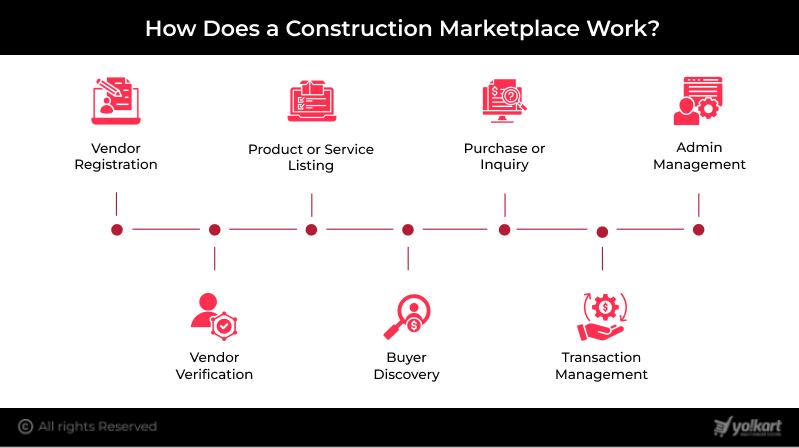
- Vendor Registration: Suppliers, contractors, equipment owners, and service providers register on the platform.
- Vendor Verification: The marketplace admin reviews business details and approves vendors based on the platform’s verification requirements.
- Product or Service Listing: Approved vendors add products or services with details such as pricing, specifications, images, availability, service areas, and minimum order quantities.
- Buyer Discovery: Buyers browse or search listings using filters such as category, location, price, specifications, ratings, and availability.
- Purchase or Inquiry: Depending on the marketplace model, buyers can place orders, request quotations, submit project requirements, or initiate rental and service bookings.
- Transaction Management: The platform facilitates payments, orders, bookings, commissions, notifications, and other transaction-related activities.
- Admin Management: Marketplace administrators oversee vendors, transactions, disputes, content, commissions, platform settings, and performance reports.
Why Build a Construction Marketplace?
The construction industry is large but highly fragmented. A single project may require products and services from multiple vendors, while suppliers and contractors need reliable channels to reach new customers. A marketplace can bring these participants together and simplify procurement, discovery, and transactions.
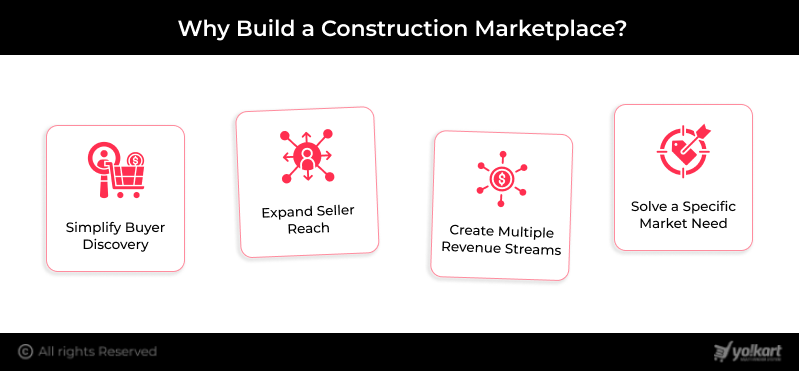
1. Simplify Buyer Discovery
Buyers can find and compare products, suppliers, contractors, and services from one platform. Features such as search, communication, quotation requests, and transaction management can reduce the need to coordinate with multiple vendors separately.
2. Expand Seller Reach
A marketplace gives suppliers and contractors an additional sales channel without requiring them to build and promote their own ecommerce infrastructure. Vendors can list products or services, manage orders and inquiries, and connect with customers beyond their existing networks.
3. Create Multiple Revenue Streams
Marketplace operators can monetize transactions and vendor participation through commissions, subscriptions, lead fees, featured listings, advertising, listing charges, or a combination of these models.
4. Solve a Specific Market Need
The strongest marketplace opportunities typically address a clear procurement or service discovery challenge. Rather than simply creating a large catalog, businesses should focus on solving a specific industry problem and making transactions easier for both buyers and sellers.
Launch a Marketplace for the Construction Industry
Construction Marketplace Business Models
There is no single business model that works for every construction marketplace. The right model depends on the audience, transaction type, geographic market, and level of specialization.
Common models include:
1. Construction Materials Marketplace
A construction materials marketplace connects buyers with suppliers selling products such as cement, steel, bricks, flooring, plumbing products, electrical materials, tools, fixtures, paints, and other building supplies. Key features can include price comparison, availability, delivery options, bulk orders, negotiated pricing, minimum order quantities, and RFQs.
2. Construction Equipment Marketplace
Construction equipment marketplaces connect customers with companies that sell or rent machinery and equipment such as excavators, cranes, loaders, forklifts, concrete mixers, generators, scaffolding, compressors, and other heavy equipment. Rental workflows should support availability, rental periods, delivery locations, deposits, equipment condition, and bookings.
3. Contractor Marketplace
A contractor marketplace connects property owners, developers, businesses, or project managers with construction professionals. Features such as verification, service areas, portfolios, quotation requests, communication, scheduling, and dispute management can play an important role in building trust.
4. Construction Services Marketplace
Some marketplaces focus specifically on construction-related services rather than physical products. Customers can post requirements and receive responses from service providers who are capable of completing the work. This model works well for specialized services where buyers benefit from comparing multiple providers.
5. Hybrid Construction Marketplace
A hybrid model combines multiple marketplace categories, such as material sales, equipment rentals, and contractor services. While the hybrid approach creates more revenue opportunities, it also increases development and operational complexity. For this reason, businesses should generally start with a clearly defined marketplace use case and expand after establishing demand.
Essential Features of a Construction Marketplace
A construction marketplace needs functionality that supports product discovery, vendor management, procurement, rental, service bookings, transactions, and marketplace administrators. The exact feature set should depend on the marketplace model and target users.
1. Product and Service Discovery
Enable buyers to search, filter, sort, and compare construction products and services based on category, price, location, specifications, brand, certifications, availability, and vendor ratings. This helps users quickly identify relevant options.
2. Vendor Management
Provide vendors with dashboards to manage profiles, listings, orders, inquiries, customers, pricing, inventory, and payments. The platform should also support vendor registration and approval workflows to maintain marketplace quality.
3. Quotation and RFQ Management
Allow buyers to submit detailed requirements and request quotations from multiple suppliers. Vendors can review requirements, submit quotations, and negotiate pricing, making the marketplace suitable for bulk and B2B procurement.
4. Bulk Ordering And Pricing
Support large-volume purchases through minimum order quantities, bulk pricing, negotiated rates, and supplier-specific pricing. This functionality is particularly relevant for contractors, builders, developers, and procurement teams.
5. Equipment Rental And Booking
For rental marketplaces, enable vendors to manage equipment availability, rental periods, pricing, deposits, and booking requests. Buyers should be able to check availability, select rental durations, and manage bookings.
6. Location-Based Discovery
Allow buyers to discover vendors based on city, region, postal code, service area, or delivery radius. Location-based functionality can help manage material delivery and improve access to nearby equipment and service providers.
7. Orders, Payments And Transactions
Support the complete transaction lifecycle, from checkout or booking to payment, order tracking, commissions, refunds, and notifications. For service-based marketplaces, the workflow can also include booking confirmation and completion.
8. Reviews and Vendor Verification
Enable vendor verification through business information and documentation, while allowing buyers to submit ratings and reviews. Project portfolios and transaction history can further help buyers evaluate vendor credibility.
9. Admin And Marketplace Management
Provide administrators with centralized controls for users, vendors, listings, categories, orders, payments, commissions, reviews, disputes, promotions, and platform settings. Reporting tools can help track sales, vendor performance, customer activity, and revenue.
Build Your Construction Marketplace With The Right Features
How to Monetize a Construction Marketplace
The marketplace can use one or multiple revenue models depending on its audience.
- Transaction commissions allow the marketplace to earn a percentage of completed transactions. This is straightforward for product purchases and bookings but requires sufficient transaction volume.
- Seller subscriptions can provide vendors with access to marketplace features in exchange for a recurring fee. This can create predictable revenue and may work well for professional suppliers.
- Lead fees can be used when the marketplace generates contractor or service inquiries rather than directly processing transactions.
- Featured listings and advertising provide additional revenue by allowing vendors to increase their visibility.
- Listing fees can also be considered, particularly in specialized marketplaces where vendors receive meaningful exposure from each published listing.
- A hybrid monetization model can provide greater flexibility, but the marketplace should avoid making the initial pricing structure unnecessarily complicated.
Construction Marketplace Development: Cost & Timeline
The cost of developing a construction marketplace depends heavily on its scope, customizations, and other requirements. A relatively simple marketplace with standard product selling functionality will require considerably less development than an enterprise platform supporting RFQs, equipment rentals, ERP integration, complex pricing, logistics, and multiple business models.
As a general planning estimate, businesses can consider the following ranges:
| Marketplace Type | Approximate Development Cost |
| Basic Construction Marketplace | $15,000-$30,000 |
| Customized Construction Marketplace | $30,000-$75,000 |
| Advanced Marketplace with RFQ & Integrations | $75,000-$150,000+ |
| Enterprise Construction Marketplace | $150,000+ |
Note: These figures should be treated as planning ranges rather than fixed quotations. Actual costs depend on the platform selected, design requirements, integrations, custom workflows, mobile applications, third-party services, geographic requirements, and the development partner.
For example, a construction materials marketplace with standard multi-vendor eCommerce functionality may be relatively straightforward. Adding supplier-specific pricing, ERP synchronization, RFQs, logistics management, credit terms, equipment rentals, and complex approval workflows can substantially increase both development effort and cost.
Timeline
Development timelines vary according to scope and implementation strategy.
- A basic construction marketplace may take approximately 3-4 months to develop and launch.
- A more customized platform may require 4-8 months, while complex marketplaces involving multiple workflows, integrations, mobile applications, and enterprise systems can require 6-12 months or longer.
Businesses should also remember that development is only one part of the launch process. Vendor onboarding, catalog preparation, payment configuration, testing, SEO, legal documentation, logistics arrangements, and marketplace marketing should be planned alongside development.
Construction Marketplace Development Process
A successful project usually begins with business and marketplace strategy rather than coding. Given below are steps included in the construction marketplace development process:
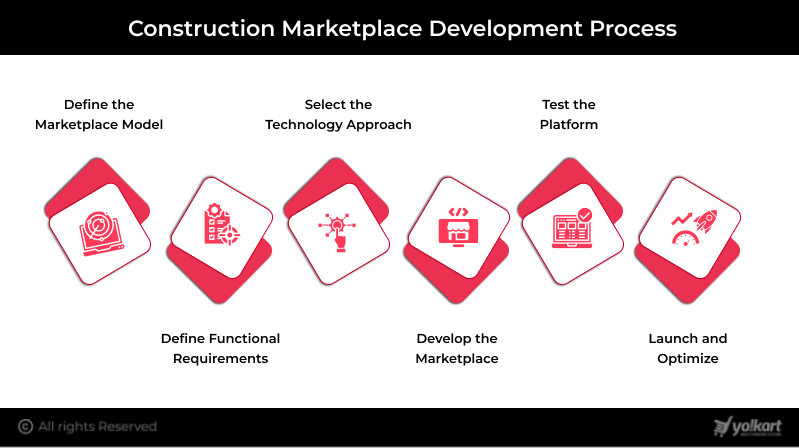
Step 1: Define the Marketplace Model
The first step is to conduct thorough market research and determine exactly what the marketplace will offer and who it will serve. The business should identify its primary customer segment, supplier segment, geography, transaction model, and initial product or service categories.
A focused marketplace is often easier to launch and validate than a platform attempting to cover every construction category from day one.
Step 2: Define Functional Requirements
Once the business model is established, the next step is to document marketplace workflows. This includes seller onboarding, product management, RFQs, pricing, orders, payments, delivery, equipment booking, reviews, disputes, and administration.
This stage is particularly important because construction businesses often have workflows that differ from standard eCommerce.
Step 3: Select the Technology Approach
Businesses usually have three approaches to choose from: custom development, a ready-made marketplace platform, or a hybrid approach.
A completely custom platform offers extensive control but requires more upfront development and ongoing technical investment. A readymade solution can provide established marketplace functionality that can then be customized around the business model.
For businesses that want marketplace functionality without building the entire foundation from scratch, Yo!Kart can be worth evaluating as a starting point. Its multi-vendor architecture can provide core functionality for managing sellers, products, customers, orders, commissions, and marketplace operations, while customization can be used to adapt the platform to construction-specific workflows.
This can be particularly useful when the objective is to avoid spending development resources recreating standard marketplace functionality and instead focus investment on differentiating features such as RFQs, bulk purchasing, equipment rental, supplier verification, location-based discovery, or industry-specific integrations.
Step 4: Develop the Marketplace
After you have finalized the development approach, implement the buyer, seller, and admin experiences along with the marketplace’s underlying business rules.
At this stage, integrations with payment gateways, shipping providers, ERP systems, CRM platforms, accounting software, analytics tools, maps, communication systems, and other third-party services may also be implemented.
Step 5: Test the Platform
Before launch, the marketplace should be tested across different user roles and transaction scenarios.
Testing should cover registration, vendor approval, product creation, search, checkout, quotation requests, payments, commissions, refunds, notifications, order management, equipment bookings, and administrative workflows where applicable.
Security, performance, mobile responsiveness, and compatibility should also be evaluated.
Step 6: Launch and Optimize
Once the marketplace is launched, the focus should shift from simply acquiring traffic to improving marketplace liquidity and transaction quality.
The operator should monitor metrics such as vendor activation, product listing growth, search activity, quotation requests, conversion rates, repeat purchases, average order value, customer acquisition cost, and vendor retention.
The data collected during the first few months can then be used to improve the platform and determine which categories or geographic markets deserve additional investment.
Yo!Kart: A Customizable Solution for Construction Marketplace Development
For businesses evaluating construction marketplace development approaches, the key question is not always whether to buy a readymade solution or build everything from scratch. There is often a middle ground: start with a proven marketplace foundation and customize it around the business’s specific requirements.
Yo!Kart follows this approach. It provides core multi-vendor eCommerce functionality that can support buyers, sellers, products, orders, commissions, payments, and marketplace administration. Businesses can then work with a development team to adapt the solution to their particular construction marketplace model.
For example, a construction materials marketplace could use the existing marketplace foundation while adding workflows around bulk purchasing, supplier-specific pricing, RFQs, delivery zones, or product specifications. An equipment marketplace could require additional customization around rental duration, availability, booking, deposits, and equipment delivery.
This approach can be especially relevant for businesses that want greater control over their marketplace than a typical SaaS solution provides but do not want to invest the time and budget required to develop every marketplace component from the ground up.
The suitability of Yo!Kart ultimately depends on the complexity of the planned marketplace. Highly specialized enterprise requirements may still require substantial customization or custom development, so the platform should be evaluated against the actual functional requirements before making a final technology decision.
See Yo!Kart In Action
Custom Development vs Yo!Kart for a Construction Marketplace
The choice between custom development and a solution such as Yo!Kart depends on the business’s priorities.
| Criteria | Custom Development | Yo!Kart |
| Flexibility | Maximum flexibility for unique requirements | Customizable marketplace foundation |
| Core Features | Built from scratch | Pre-built multi-vendor functionality |
| Customization | Complete control | Focused on industry-specific needs |
| Development Effort | Higher | Lower foundational effort |
| Implementation | Generally takes longer | Faster to implement |
| Maintenance | Full platform maintenance required | Customization and ongoing development as needed |
| Complex Requirements | Suitable for highly specialized needs | Suitable with additional customization |
| Best For | Complete control and unique workflows | Faster launch with customization and lower development effort |
How to Choose a Construction Marketplace Development Company
Choosing the right development partner can directly affect the marketplace’s scalability, functionality, and long-term performance. Evaluate the company based on its marketplace expertise, understanding of construction workflows, technical capabilities, and ownership terms.
- Marketplace Experience: Look for experience with multi-vendor solutions, seller management, commissions, RFQs, vendor onboarding, and marketplace administration.
- Industry Understanding: Ensure the team can translate requirements such as equipment rentals, bulk orders, supplier negotiations, and contractor services into practical workflows.
- Technical Expertise: Evaluate expertise, API integrations, customization, security, scalability, mobile development, deployment, maintenance, and post-launch support.
- Ownership and Licensing: Clarify what you own, what is licensed, how custom development is handled, and whether another development partner can take over if required.
- End-to-End Support: Consider providers that can support platform selection, customization, integrations, development, and ongoing maintenance under one engagement.
Requirement Mapping: Define your workflows first, then determine which requirements can be supported through the existing Yo!Kart foundation and which require customization.
Common Construction Marketplace Development Mistakes
Construction marketplaces involve complex procurement and operational workflows, making it easy to overlook important areas during development. Avoiding these common mistakes can help create a more focused and sustainable marketplace.
- Launching Too Broadly: Avoid starting with too many categories, services, or geographic markets. Begin with a focused use case and expand based on demand.
- Ignoring Supplier Acquisition: A feature-rich marketplace with limited vendors or inventory may struggle to attract buyers. Plan supplier acquisition alongside development.
- Weak Vendor Verification: Establish appropriate verification and trust mechanisms, particularly for high-value construction transactions.
- Overlooking Procurement Needs: Support workflows such as RFQs, bulk pricing, credit terms, approvals, documentation, and negotiation where relevant.
- Underestimating Operations: Plan for ongoing customer support, vendor management, content moderation, dispute resolution, SEO, marketing, and platform optimization.
Get Your Construction Marketplace Development Strategy Right
Final Thoughts
A construction marketplace can address a fragmented industry by connecting buyers, suppliers, contractors, and service providers through one digital platform. However, the success of the platform will depend on much more than the technology used to build it.
A focused business model, sufficient supplier supply, a strong buyer experience, appropriate trust mechanisms, efficient transaction workflows, and a sustainable customer acquisition strategy are equally important.
From a technology perspective, businesses can choose custom development, a ready-made marketplace platform, or a combination of both. For businesses seeking customization without building every marketplace component from scratch, Yo!Kart can provide a practical foundation with core multi-vendor functionality.
The right approach ultimately depends on the marketplace model, required integrations, scale, budget, and long-term technology strategy. Businesses working with FATbit Technologies can first define their requirements and then determine what can be supported through Yo!Kart, what needs customization, and what may require separate development.
Frequently Asked Questions
How much does it cost to build a construction marketplace?
The cost to build a construction marketplace depends on the marketplace’s scope and complexity. A basic platform may cost around $15,000-$30,000, while customized implementations can reach $75,000-$150,000 or more. Enterprise platforms with advanced integrations, rentals, RFQs, and complex workflows may require a significantly larger investment.
How long does it take to develop a construction marketplace?
A basic construction marketplace can take around 3-4 months to develop. Customized implementations may require approximately 4-8 months, while complex enterprise marketplaces involving multiple workflows, integrations, mobile apps, or enterprise systems can take 6-12 months or longer.
Can Yo!Kart be used to build a construction marketplace?
Yes, Yo!Kart can be used as a foundation for a construction marketplace because it provides core multi-vendor marketplace functionality. However, construction-specific requirements such as RFQs, bulk purchasing, equipment rentals, specialized pricing, or industry integrations may require additional customization.
Should I build a construction marketplace from scratch or use a ready-made platform?
The decision depends on the complexity of the business model, budget, timeline, and customization requirements. Custom development provides maximum flexibility, while a readymade solution such as Yo!Kart can reduce the need to develop standard marketplace functionality from scratch and allow resources to focus on industry-specific functionality.
What features are important for a construction materials marketplace?
Important features for a construction materials marketplace include:
- Advanced product search
- Supplier management
- Bulk ordering
- RFQs
- Negotiated pricing
- Inventory management
- Payments
- Delivery management
- Vendor verification
- Reviews
- Order management
- ERP
- Accounting integrations
Can a construction marketplace include equipment rentals?
Yes, a construction marketplace can include equipment rentals. However, equipment rental functionality requires workflows that differ from normal product sales, including availability management, rental periods, booking requests, deposits, delivery arrangements, and cancellation policies. Equipment owners should also be able to manage when their assets are available.
How does a construction marketplace make money?
A construction marketplace can generate revenue through transaction commissions, seller subscriptions, lead fees, featured listings, advertising, listing fees, and booking or transaction charges. Businesses can also combine multiple models, although keeping the initial pricing structure simple can make adoption easier for buyers and sellers.
What is the biggest challenge in launching a construction marketplace?
One of the biggest challenges in launching a construction marketplace is achieving marketplace liquidity. You need enough reliable suppliers and useful inventory to attract buyers while simultaneously acquiring enough buyers to make participation worthwhile for suppliers. Vendor and buyer acquisition should therefore be planned together with technology development.