

Published Date 03rd Jun, 2026
What do Amazon, Etsy, Alibaba, and eBay have in common? Beyond their global recognition, they have all leveraged the marketplace model to build thriving digital ecosystems that connect buyers and sellers at scale. As consumer expectations evolve and online commerce continues to expand, marketplace businesses are increasingly outperforming traditional eCommerce stores in terms of scalability, product diversity, and revenue potential.
For entrepreneurs and enterprises looking to capitalize on this opportunity, selecting the right marketplace platform is a critical decision. The ideal eCommerce marketplace platform not only simplifies marketplace management but also provides the flexibility, scalability, and features needed to support long-term business growth.
With numerous marketplace platforms available, identifying the right solution can be challenging. Each platform offers unique capabilities, pricing models, customization options, and business advantages.
This guide explores the best marketplace platforms for growing eCommerce businesses and highlights the key factors to consider when making your decision.
Table of Contents
- What is an eCommerce Marketplace Platform?
- Why Growing eCommerce Businesses Need a Marketplace Platform?
- Key Features to Look for in a Marketplace Platform
- Best Marketplace Platforms for Growing eCommerce Businesses
- How to Choose the Right Marketplace Platform
- Why White-Label Marketplace Software is Gaining Popularity?
- How Yo!Kart Helps Businesses Launch Online Marketplaces
- Conclusion
- FAQs
What is an eCommerce Marketplace Platform?
An eCommerce marketplace platform is software that enables businesses to create and manage online marketplaces where multiple vendors can register, list products or services, and sell to customers through a single website or mobile application. Unlike a traditional online store where a single business manages inventory and sales, a marketplace platform supports multiple independent sellers operating under one digital ecosystem.
The marketplace owner facilitates transactions, manages vendor operations, and earns revenue through commissions, subscriptions, advertisements, featured listings, or transaction fees. This approach allows businesses to expand product offerings, attract a broader customer base, and scale more efficiently without directly managing inventory.
Some of the world’s most successful marketplaces include Amazon, Etsy, Alibaba, eBay, and Walmart Marketplace. Their success highlights the growing demand for platforms that connect buyers and sellers while creating sustainable revenue opportunities.
Modern marketplace platforms support a wide range of business models, allowing entrepreneurs to choose a structure that aligns with their target audience and business objectives. Some of the popular bsuiness models are:
B2C Marketplaces
Business-to-consumer (B2C) marketplaces enable businesses and brands to sell products directly to end customers through a centralized platform. These marketplaces typically offer a wide range of products, streamlined checkout experiences, and competitive pricing.
Popular examples include Amazon and Walmart Marketplace.
B2B Marketplaces
Business-to-business (B2B) marketplaces connect manufacturers, wholesalers, distributors, and suppliers with other businesses seeking products or services in bulk. These platforms often support custom pricing, bulk ordering, negotiated contracts, and specialized procurement workflows.
Alibaba is a well-known example of a B2B marketplace.
C2C Marketplaces
Consumer-to-consumer (C2C) marketplaces allow individuals to buy and sell products or services directly with one another. The marketplace acts as an intermediary by facilitating listings, payments, and communication between users.
Platforms such as eBay and Facebook Marketplace are popular examples of this model.
Service Marketplaces
Service marketplaces connect customers with professionals, freelancers, or service providers offering specialized expertise. These platforms simplify service discovery, booking, payments, and reviews, making it easier for users to find trusted providers.
Examples include Upwork, Fiverr, and TaskRabbit.
Rental and Booking Marketplaces
Rental and booking marketplaces enable users to rent products, properties, vehicles, equipment, or reserve services online. These platforms typically include scheduling, availability management, secure payments, and booking confirmations.
Airbnb and Turo are prominent examples of this marketplace category.
Regardless of the business model, a robust marketplace platform provides the technological foundation needed to launch, manage, and scale a successful marketplace. Whether targeting products, services, rentals, or business transactions, the right platform provides the foundation needed to attract vendors, engage customers, and drive sustainable growth.
Launch a Scalable Multi-Vendor Marketplace Tailored to Your Business Model
Why Growing eCommerce Businesses Need a Marketplace Platform?
As eCommerce businesses grow, scaling a traditional online store often becomes increasingly challenging. Managing inventory, sourcing products, handling logistics, and maintaining supplier relationships can become increasingly complex and expensive as the business expands.
A marketplace platform helps overcome these challenges by allowing third-party vendors to contribute products, services, and inventory. This approach enables businesses to scale faster while reducing operational burdens and creating new revenue opportunities.
1. Unlimited Product Expansion
One of the biggest limitations of a traditional eCommerce store is the need to manage and invest in inventory. With a marketplace platform, businesses can onboard multiple vendors who contribute their own products and catalogs. As new vendors join, the marketplace can rapidly expand its product catalog, offer greater variety to customers, and enter new categories without requiring additional inventory investments. This significantly expands product offerings without requiring additional inventory investments from the marketplace owner.
2. Multiple Revenue Streams
One of the biggest advantages of operating a marketplace is the ability to generate revenue from multiple sources. Marketplace owners can monetize their platform through:
- Commission fees on sales
- Vendor subscription plans
- Featured product listings
- Advertising opportunities
- Transaction processing fees
- Premium membership programs
This diversifying revenue sources, businesses can reduce dependency on a single income stream, improve profitability, and build a more sustainable and resilient business model.
3. Lower Operational Costs
Managing inventory, warehousing, and fulfillment can become increasingly challenging as an eCommerce business grows. In a marketplace environment, vendors are typically responsible for maintaining their own inventory, updating product information, and fulfilling orders. This minimizes the need for warehousing, inventory management, and procurement activities while allowing the business to focus on platform growth and customer acquisition.
4. Faster Business Scaling
Scaling a traditional online store often requires substantial investments in inventory, infrastructure, and supplier relationships. A marketplace platform offers a more flexible growth model by enabling businesses to onboard new vendors instead of managing every expansion internally. This approach allows marketplace owners to quickly enter new product categories, target additional customer segments, and expand into new geographic markets while maintaining operational efficiency.
5. Improved Customer Experience
A marketplace platform brings together multiple vendors and brands under one digital ecosystem, giving customers access to a broader range of products and services. This increased variety, combined with improved product availability and pricing competition, creates a richer shopping experience that can drive customer satisfaction, encourage repeat purchases, and strengthen long-term customer loyalty.
6. Network Effect Advantage
Network effects are one of the strongest growth drivers behind successful marketplace businesses. As more vendors join the platform, product variety and availability increase, attracting more customers. The growing customer base, in turn, makes the marketplace more attractive to additional vendors. This self-reinforcing cycle creates sustainable growth and strengthens the marketplace’s competitive position.
Key Features to Look for in a Marketplace Platform
Choosing the right eCommerce marketplace platform requires evaluating features that directly influence operational efficiency, vendor satisfaction, customer experience, and long-term business growth. A well-equipped platform should provide the tools needed to manage multiple sellers, streamline transactions, and scale seamlessly as your marketplace expands.
Evaluate the following features can help ensure your marketplace is built on a strong and future-ready foundation:
Multi-Vendor Management
Multi-vendor functionality is the foundation of any successful marketplace. The platform should simplify seller onboarding while empoering vendors to manage their operations independently through dedicated tools and dashboards.
Key capabilities include:
- Vendor registration and onboarding
- Approval and verification workflows
- Dedicated seller dashboards
- Product and inventory management
- Vendor performance monitoring
- Communication tools for sellers and administrators
A robust vendor management system reduces administrative workload while ensuring a smooth experience for both sellers and marketplace operators.
Commission Management
A marketplace’s profitability largely depends on its ability to implement flexible monetization strategies. Therefore, the platform should offer flexible commission management options that allow businesses to implement different monetization strategies.
Important features include:
- Percentage-based commissions
- Fixed transaction fees
- Category-specific commission structures
- Vendor-specific commission rates
- Subscription-based seller plans
- Automated commission calculations
Flexible commission settings enable marketplace owners to maximize profitability while maintaining competitive seller relationships.
Product Catalog Management
As marketplaces grow, managing thousands of products across multiple vendors becomes increasingly complex. An effective catalog management system helps maintain consistency, improve product discoverability, and delivers a better shopping experience.
Essential capabilities include:
- Bulk product uploads and imports
- Product variations and attributes
- Inventory tracking and stock management
- Product approval and moderation workflows
- Category and brand management
- Advanced search and filtering options
A well-organized product catalog improves discoverability and helps customers find relevant products quickly.
Order Management
Efficient order processing is essential for maintaining customer satisfaction and ensuring smooth marketplace operations. The platform should provide centralized control over all order-related activities.
Core functionalities include:
- Order tracking and management
- Refund and return processing
- Shipping and delivery management
- Fulfillment coordination
- Automated notifications and updates
- Dispute resolution support
Comprehensive order management tools help streamline operations and improve the overall customer experience.
Multiple Payment Gateways
Modern marketplaces serve customers across different regions and demographics, making payment flexibility a critical requirement. The platform should support multiple payment gateways while enabling secure and automated vendor payouts.
Key features include:
- Integration with major payment providers
- Multi-currency payment support
- Automated vendor settlements
- Secure transaction processing
- Split payment functionality
- International payment compatibility
Offering flexible payment options can significantly improve conversion rates and customer trust.
Mobile Responsiveness
With a large percentage of online purchases occurring on mobile devices, mobile responsiveness is no longer optional. Your marketplace should deliver a seamless experience across smartphones, tablets, and desktops.
Important considerations include:
- Responsive website design
- Fast mobile page loading speeds
- Mobile-friendly navigation
- Optimized checkout experience
- Cross-device compatibility
A mobile-optimized marketplace enhances user engagement and contributes to higher conversion rates.
Launch Your Own Mobile-Ready Multi-Vendor Marketplace
SEO Features
Organic visibility plays a crucial role in customer acquisition and long-term marketplace growth. A platform with built-in SEO tools helps improve search rankings and attract high-intent traffic without relying solely on paid advertising.
Essential SEO features include:
- SEO-friendly URLs
- Custom meta titles and descriptions
- Schema markup support
- XML sitemap generation
- Canonical tag management
- Blog and content marketing integration
Strong SEO capabilities help marketplaces improve search rankings and attract qualified traffic consistently.
Scalability
As your marketplace grows, the platform should be capable of handling increased demand without compromising performance or user experience. Scalability ensures that the system remains reliable as business operations expand.
The platform should support growth in:
- Website traffic
- Number of vendors
- Product listings
- Customer accounts
- Transaction volumes
- Geographic expansion
A scalable marketplace platform minimizes future migration challenges and supports sustainable growth.
Security
Trust is a cornerstone of marketplace success. Protecting customer information, vendor data, and financial transactions should be a top priority when evaluating marketplace platforms.
Important security features include:
- SSL certification and encryption
- Secure payment processing
- Data protection mechanisms
- GDPR and privacy compliance
- Role-based access controls
- Fraud detection and prevention tools
Strong security measures reduce risks and safeguard the marketplace ecosystem.
Customization Capabilities
No two marketplaces operate exactly alike. Whether it’s branding, workflows, or user experiences, the platform should offer sufficient flexibility to adapt to changing business goals.
Customization options should include:
- Design and branding modifications
- Workflow customization
- Feature enhancements and integrations
- User experience personalization
- API access for third-party tools
- Custom development support
A highly customizable marketplace platform allows businesses to create a distinctive user experience while maintaining a competitive advantage.
Best Marketplace Platforms for Growing eCommerce Businesses
Selecting the right marketplace platform is one of the most important decisions for any business planning to build a scalable multi-vendor ecosystem. The ideal solution should offer robust vendor management, flexible customization, strong security, and the ability to support future growth.
Below are some of the top marketplace platforms that cater to different business sizes, industries, and marketplace models.
1. Yo!Kart
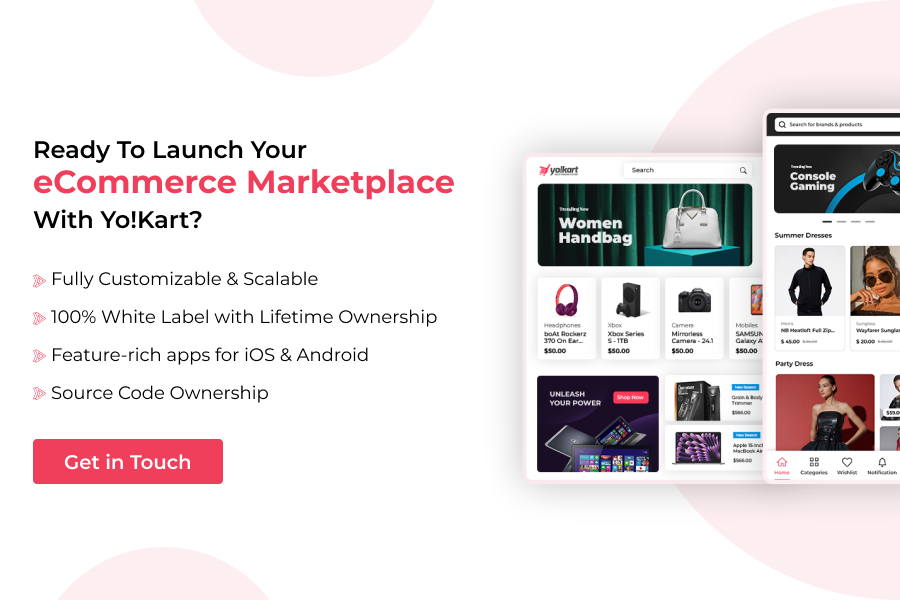
Yo!Kart is a self-hosted, white-label multi-vendor marketplace platform designed for startups, SMBs, and enterprises looking to launch scalable online marketplaces. Built specifically for marketplace businesses, it comes with a comprehensive set of native features that reduce dependency on third-party plugins and integrations.
The platform supports a wide range of marketplace models, including B2C, B2B, wholesale, rental, and niche marketplaces. It combines complete ownership, extensive customization capabilities, and long-term scalability, making it a preferred choice for businesses seeking long-term scalability and complete control over their marketplace operations.
Key Features
- Multi-vendor management
- Dedicated vendor dashboards
- Product catalog and inventory management
- Flexible commission management
- Tax and shipping management
- Multiple payment gateway integrations
- Mobile-responsive storefronts
- Abandoned cart recovery
- Multi-language support
- Multi-currency functionality
- Advanced analytics and reporting
- White-label ownership
- Role-based admin controls
Pros
- One-time license fee with no recurring commissions
- Complete source code ownership
- Highly customizable and scalable
- Built specifically for marketplace businesses
- Supports multiple business models
- Strong security and performance capabilities
- Cost-effective for long-term growth
Pricing
Yo!Kart follows a one-time licensing model, allowing businesses to avoid recurring subscription fees. This pricing structure makes it particularly attractive for organizations planning to scale their marketplace over time while maintaining predictable operational costs.
Best For
- Startups launching new marketplaces
- Small and medium-sized businesses
- Enterprise marketplace projects
- B2B marketplaces
- Wholesale marketplaces
- Rental marketplaces
- Niche marketplace businesses
Schedule a One-on-One Demo to See Yo!Kart in Action
2. Sharetribe
Sharetribe is a cloud-based marketplace platform that enables entrepreneurs to launch online marketplaces quickly without extensive technical expertise. It is particularly popular among startups looking to validate marketplace ideas and launch minimum viable products (MVPs).
The platform supports service, rental, and product marketplaces and offers both no-code and developer-friendly options for customization.
Key Features
- No-code marketplace builder
- Vendor and user management
- Booking and scheduling functionality
- Secure payment integrations
- API access for customization
- Responsive marketplace templates
- Transaction management tools
- Messaging functionality
Pros
- Fast marketplace deployment
- Beginner-friendly interface
- Suitable for MVP development
- Flexible API capabilities
- Cloud-hosted infrastructure
Pricing
Sharetribe operates on a subscription-based pricing model with multiple plans designed for startups and growing businesses.
Best For
- Service marketplaces
- Rental marketplaces
- Peer-to-peer platforms
- MVP launches
- Entrepreneurs testing marketplace concepts
3. Mirakl
Mirakl is an enterprise-grade eCommerce marketplace platform designed for large retailers, manufacturers, and organizations seeking advanced marketplace capabilities. It is widely recognized for helping enterprises expand product offerings through third-party sellers.
The platform focuses on automation, operational efficiency, and large-scale marketplace management.
Key Features
- Enterprise vendor management
- Automated seller onboarding
- Advanced analytics and reporting
- Workflow automation
- Enterprise integrations
- Product catalog management
- Marketplace performance monitoring
- Global commerce support
Pros
- Enterprise-level scalability
- Robust infrastructure
- Extensive integration ecosystem
- Strong automation capabilities
- Proven success with large organizations
Pricing
Mirakl offers custom pricing based on business requirements, marketplace size, and implementation scope.
Best For
- Large retailers
- Enterprise organizations
- Global marketplace operators
- Businesses managing large seller networks
4. Magento Marketplace (Adobe Commerce)
Adobe Commerce, formerly Magento Commerce, is a powerful eCommerce platform that can be transformed into a marketplace through extensions and custom development. It offers extensive flexibility and customization options for businesses with complex requirements.
Its strong ecosystem and enterprise-grade capabilities make it a popular choice among medium and large organizations.
Key Features
- Advanced product management
- Enterprise-grade security
- Extensive customization capabilities
- Multi-store management
- Customer segmentation tools
- Marketing and promotional features
- Third-party extension ecosystem
- Advanced reporting tools
Pros
- Highly flexible architecture
- Large developer community
- Extensive extension marketplace
- Enterprise-level performance
- Strong content management capabilities
Pricing
Adobe Commerce follows a premium pricing structure, with costs varying based on business size and implementation requirements.
Best For
- Medium-sized businesses
- Large enterprises
- Complex eCommerce operations
- Businesses requiring extensive customization
5. Shopify Plus
Shopify Plus is Shopify’s enterprise solution that enables businesses to create marketplace-like experiences through apps, integrations, and custom development. It combines ease of use with reliable cloud infrastructure.
The platform is particularly attractive for brands seeking rapid deployment and simplified marketplace management.
Key Features
- Fully hosted infrastructure
- Extensive app ecosystem
- Global payment support
- Multi-channel selling
- Automation tools
- Mobile-responsive storefronts
- Advanced analytics
- API integrations
Pros
- Easy to manage and maintain
- Reliable hosting and security
- Quick deployment process
- Strong ecosystem of apps
- Excellent user experience
Pricing
Shopify Plus operates on a monthly subscription model with enterprise-level pricing.
Best For
- Growing D2C brands
- Retail businesses
- Established online stores
- Businesses seeking managed infrastructure
6. CS-Cart Multi-Vendor
CS-Cart Multi-Vendor is a dedicated marketplace platform built specifically for managing multiple vendors within a single storefront. It offers extensive marketplace functionality out of the box and supports businesses across various industries.
The platform provides marketplace owners with strong control over vendor operations and marketplace performance.
Key Features
- Vendor storefronts
- Commission management systems
- Product catalog management
- Marketing and promotion tools
- Vendor payout management
- Order management
- Mobile-responsive design
- Reporting and analytics
Pros
- Marketplace-focused architecture
- Comprehensive built-in features
- Strong vendor management tools
- Flexible customization options
- Self-hosted ownership model
Pricing
CS-Cart Multi-Vendor follows a license-based pricing model with different editions available for varying business needs.
Best For
- Mid-sized marketplace businesses
- Product marketplaces
- Regional marketplace operators
- Businesses seeking self-hosted solutions
7. Arcadier
Arcadier is a cloud-based marketplace builder that supports multiple marketplace models, including product, service, booking, and rental marketplaces. It offers a flexible environment for entrepreneurs looking to launch marketplaces without extensive development resources.
Its modular approach allows businesses to add functionality as their marketplace grows.
Key Features
- Marketplace templates
- Vendor management tools
- API integrations
- Booking and scheduling support
- Payment gateway integrations
- Mobile-responsive design
- User management capabilities
- Marketplace customization options
Pros
- Easy marketplace setup
- Supports multiple marketplace models
- Cloud-hosted convenience
- Flexible customization options
- Suitable for startups
Pricing
Arcadier offers subscription-based pricing plans designed for businesses at different growth stages.
Best For
- Startups
- Entrepreneurs
- Service marketplaces
- Rental marketplaces
- Businesses launching MVPs
8. Marketplacer
Marketplacer is an enterprise marketplace platform designed to help businesses connect buyers and sellers through scalable digital commerce ecosystems. It is widely used by organizations looking to expand product offerings and create marketplace-driven growth strategies.
The platform emphasizes enterprise integrations, operational efficiency, and global commerce capabilities.
Key Features
- Enterprise integrations
- Vendor onboarding and management
- Global commerce support
- Product catalog synchronization
- Marketplace automation tools
- Order management capabilities
- Analytics and reporting
- API-driven architecture
Pros
- Enterprise-ready infrastructure
- Strong scalability
- Advanced integration capabilities
- Supports large seller networks
- Suitable for global operations
Pricing
Marketplacer offers customized pricing based on marketplace requirements, transaction volume, and implementation complexity.
Best For
- Large-scale marketplace projects
- Enterprise organizations
- Retail marketplace expansion
- Businesses operating across multiple regions and markets
9. Dokan
Dokan is a popular multi-vendor marketplace solution built for WordPress and WooCommerce. It allows businesses to transform a WooCommerce store into a marketplace where multiple vendors can manage products, orders, and customers independently.
Key Features
- Multi-vendor functionality
- Vendor dashboards
- Commission management
- Product management
- WooCommerce integration
- Multiple payment gateways
- Vendor withdrawal system
Pros
- Easy setup for WordPress users
- Affordable entry cost
- Large plugin ecosystem
- Flexible customization options
Pricing
Annual subscription plans with additional costs for premium extensions.
Best For
- Small businesses
- WordPress users
- Startup marketplaces
- Niche product marketplaces
Looking for a Reliable Marketplace Platform for Your Growing eCommerce Business?
10. BigCommerce Multi-Vendor Marketplace
BigCommerce enables marketplace functionality through third-party integrations and custom development. Known for its scalability and SaaS infrastructure, it offers a strong foundation for growing marketplace businesses.
Key Features
- Enterprise-grade hosting
- Multi-channel commerce
- API-first architecture
- Product management
- SEO-friendly framework
- Global selling capabilities
Pros
- Highly scalable
- Reliable performance
- Strong SEO capabilities
- Flexible integrations
Pricing
Subscription-based pricing with enterprise plans available.
Best For
- Growing eCommerce brands
- Enterprise businesses
- Businesses requiring omnichannel selling
Comparison Table
| Platform | Deployment | Pricing Model | Customization | Scalability | Best For |
| Yo!Kart | Self-Hosted | One-Time License | High | High | Startups to Enterprises |
| Sharetribe | Cloud | Subscription | Medium | Medium | MVPs & Service Marketplaces |
| Mirakl | Enterprise | Custom | High | High | Large Enterprises |
| Adobe Commerce | Self-Hosted/Cloud | Premium License | High | High | Large Businesses |
| Shopify Plus | SaaS | Subscription | Medium | High | D2C Brands |
| CS-Cart Multi-Vendor | Self-Hosted | License-Based | High | High | Product Marketplaces |
| Arcadier | Cloud | Subscription | Medium | Medium | Startups |
| Marketplacer | Enterprise | Custom | High | High | Large Marketplaces |
| Dokan | WordPress | Subscription | Medium | Medium | SMBs |
| BigCommerce | SaaS | Subscription | Medium | High | Growing Brands |
How to Choose the Right Marketplace Platform?
With numerous marketplace platforms available, selecting the right one requires careful evaluation of your business goals, technical requirements, and growth plans. Therefore, it is important to evaluate each option based on your business objectives, technical requirements, budget, and future growth plans.
1. Define Your Marketplace Model
Start by identifying the type of marketplace you want to build. Different platforms are designed to support specific marketplace models and may offer specialized features tailored to particular business needs. Whether you’re launching a B2C marketplace, B2B marketplace, C2C platform, service marketplace, or rental marketplace, selecting a solution that aligns with your business model will help streamline operations and reduce the need for extensive customizations.
2. Evaluate Ownership and Control
Businesses planning long-term growth often prefer self-hosted solutions that provide customization freedom, control over customer and vendor data, security management, and the ability to operate without being restricted by third-party platform policies. Greater ownership gives businesses the flexibility to adapt their marketplace as market demands evolve.
3. Consider Scalability
Your marketplace platform should be capable of supporting future growth without requiring migration to another system. When evaluating scalability, consider whether the platform can efficiently support increasing website traffic, larger product catalogs, growing vendor networks, higher transaction volumes, and international expansion.
4. Analyze Total Cost of Ownership
Do not focus solely on the initial setup cost. The total cost of ownership often extends far beyond the upfront investment. Factors such as licensing fees, recurring subscription costs, hosting expenses, customization requirements, maintenance charges, and third-party integrations can significantly impact long-term costs. Evaluating the complete financial picture will help you make a more informed investment decision.
5. Assess Customization Requirements
Every marketplace has unique workflows and branding needs. Choose a platform that allows you to customize the user interface, modify business workflows, integrate third-party applications, add new features, and personalize user experiences. A highly customizable platform enables businesses to differentiate themselves from competitors while adapting to changing customer expectations and market opportunities.
6. Review Support and Development Services
Reliable technical support can significantly impact marketplace success. Look for vendors that offer technical assistance, product documentation, implementation guidance, marketplace consulting, custom development services, and post-launch maintenance support. Reliable support helps reduce downtime, resolve issues quickly, and ensures your marketplace continues to operate efficiently as it grows.
Why White-Label Marketplace Software is Gaining Popularity?
As marketplace businesses continue to grow across industries, entrepreneurs and enterprises are increasingly turning to white-label marketplace software as a faster and more cost-effective alternative to custom development. Instead of investing months in building a marketplace from the ground up, businesses can leverage ready-made solutions that come equipped with essential marketplace functionality, enabling them to launch quickly and focus on growth.
Additionally, white-label marketplace software reduces development risks by providing a proven technology framework that has already been tested in real-world marketplace environments. With built-in scalability, customization flexibility, and complete branding control, these solutions allow businesses to establish a unique marketplace presence while minimizing both upfront investment and time-to-market.
Key Reasons Behind the Growing Adoption of White-Label Marketplace Software:
- Faster Time-to-Market: Launch your marketplace quickly with pre-built features and ready-to-deploy functionality.
- Lower Development Costs: Reduce upfront investment by eliminating the need for extensive custom development.
- Proven Marketplace Functionality: Access tested marketplace features that minimize technical risks and development challenges.
- Built for Scalability: Easily accommodate growing vendors, customers, products, and transaction volumes.
- Complete Branding Control: Create a fully branded marketplace experience without third-party platform branding.
- Greater Customization Flexibility: Adapt features, workflows, and integrations to meet unique business requirements.
- Long-Term Cost Efficiency: Lower operational expenses and achieve better ROI with ownership-based solutions.
How Yo!Kart Helps Businesses Launch Online Marketplaces?
Yo!Kart has established itself as one of the top marketplace platforms for entrepreneurs and organizations looking to build scalable online marketplaces. Designed specifically for multi-vendor commerce, it combines marketplace-focused functionality, extensive customization capabilities, and complete ownership, enabling businesses to launch, manage, and scale their marketplaces with confidence.
Key reasons to select Yo!Kart includes:
Purpose-Built for Marketplace Businesses
Unlike traditional eCommerce platforms that require extensive marketplace extensions, Yo!Kart is designed specifically for multi-vendor marketplace operations. Its built-in marketplace functionality streamlines vendor management, product listings, order processing, and revenue generation, helping businesses launch faster and operate more efficiently.
White-Label Ownership
Yo!Kart provides businesses with complete ownership and control over their marketplace ecosystem. From customizable source code to independent hosting and data ownership, businesses gain the flexibility to shape their marketplace according to their unique operational and growth requirements without platform dependency.
Multiple Marketplace Models
Whether you’re building a B2C marketplace, B2B trading platform, wholesale marketplace, rental marketplace, or hyperlocal commerce platform, Yo!Kart offers the flexibility to support diverse business models. This versatility allows businesses to adapt their marketplace strategy and expand into new opportunities as market demands evolve.
Advanced Vendor Management
Managing multiple sellers becomes significantly easier with Yo!Kart’s comprehensive vendor management capabilities. The platform helps administrators streamline vendor onboarding, configure commission structures, oversee product approvals, monitor seller performance, and maintain smooth communication, creating a more organized and efficient marketplace environment.
Global Marketplace Readiness
For businesses planning international expansion, Yo!Kart includes features designed to support global commerce. Multi-language support, multi-currency functionality, global payment gateway integrations, and tax management tools enable marketplace operators to serve customers and vendors across different regions with ease.
Cost-Effective Long-Term Investment
Its one-time license model help businesses achieve better ROI. By eliminating recurring subscription fees, the platform helps reduce operational costs, and provide greater financial predictability as the marketplace scales over time.
Turn Your Marketplace Idea into Reality
Conclusion
The marketplace economy continues to transform global commerce, creating new growth opportunities for startups, entrepreneurs and established enterprises. However, building a successful marketplace business depends heavily on selecting the right marketplace platform.
When evaluating marketplace solutions, businesses should prioritize capabilities such as vendor management, scalability, customization flexibility, security, and revenue-generation capabilities. While several solutions serve different business needs, Yo!Kart distinguishes itself as a comprehensive white-label marketplace platform that combines ownership, scalability, and marketplace-specific functionality.
Whether you are launching a B2C marketplace, B2B marketplace, rental platform, or niche marketplace business, investing in the right technology foundation can significantly influence your long-term growth and profitability.
FAQs
Q 1. What is a marketplace platform?
Ans. A marketplace platform is software that enables multiple vendors or service providers to sell products or services through a single online marketplace operated by a marketplace owner. It helps maketplace owners manage, vendors, products, orders, payments, and customer interactions from one centralized system.
Q 2. Which is the best marketplace platform for growing businesses?
Ans. The best marketplace platform depends on business requirements. However, Yo!Kart, Mirakl, Sharetribe, CS-Cart Multi-Vendor, and Shopify Plus are among the leading options available, each offering unique strengths for different marketplace types.
Q 3. What is the difference between a marketplace and an eCommerce store?
Ans. An eCommerce store typically sells products or services from a single business. A marketplace, on the other hand, allows multiple vendors to sell through one platform, giving customers access to a wider selection while enabling the platform owner to earn commissions or service fees.
Q 4. Why is white-label marketplace software preferred over custom development?
Ans. White-label marketplace software offers faster deployment, lower development costs, proven functionality, and easier scalability compared to building a marketplace from scratch. Since core marketplace features are already built and tested, companies can focus on branding, customization, and growth instead of spending months developing a platform from scratch.
Q 5. Is Yo!Kart suitable for B2B marketplaces?
Ans. Yes, Yo!Kart is designed to support various marketplace models, including B2B, B2C, wholesale, rental, and niche marketplace models. Its flexibility, customization capabilities, and vendor management features make it suitable for businesses targeting B2B commerce.
Q 6. What features should I prioritize when choosing a marketplace platform?
Ans. Key features that support long-term growth include:
- Multi-vendor management
- Commission management
- Payment integrations
- Scalability
- SEO capabilities
- Security
- Customization options
Kickstart Your Multi-Vendor Marketplace Journey with the Best Marketplace Platform
Get StartedPopular Posts