
Published Date 14 July, 2026
Quick Answer
To build an eCommerce marketplace like Temu, start by identifying your target niche, validating market demand, selecting a suitable marketplace business model, defining the essential platform features, and choosing scalable marketplace software. Once your platform is ready, focus on onboarding quality vendors, launching effective marketing campaigns, and continuously optimizing the marketplace based on user feedback.
Additionally, using a white-label marketplace solution like Yo!Kart enables entrepreneurs to reduce development time, lower costs, and launch a scalable multi-vendor marketplace much faster than building from scratch.
Introduction
The rapid rise of Temu has reshaped the global eCommerce landscape, demonstrating how a well-executed multi-vendor marketplace can attract millions of shoppers through an extensive product catalog, competitive pricing, engaging shopping experiences, and a seamless shopping experience. By connecting buyers directly with a vast network of manufacturers and merchants, Temu has inspired startups, retailers, wholesalers, and enterprises to explore similar marketplace business models.
However, launching an online marketplace like Temu requires creating a scalable ecosystem where buyers and sellers can interact seamlessly, managing vendors efficiently, ensuring secure transactions, and delivering a superior customer experience. Fortunately, today, advanced white-label marketplace software solutions make it possible for entrepreneurs to launch feature-rich multi-vendor marketplaces significantly faster while reducing both development costs and technical complexities.
In this guide, you’ll learn how Temu’s marketplace works, why it has become one of the fastest-growing online marketplaces, and the step-by-step process to build a marketplace inspired by its success. Moreover, we will also discuss the essential features, estimated development costs, common challenges, and how choosing the right marketplace software can help you launch more efficiently.
Table of Contents
- What is Temu?
- Why Has Temu Become One of the Fastest-Growing Online Marketplaces?
- Can You Build an eCommerce Marketplace Like Temu?
- Step-by-Step Guide to Build an eCommerce Marketplace Like Temu
- Essential Features of a Marketplace Like Temu
- How Much Does it Cost to Build a Marketplace Like Temu?
- Common Challenges in Building a Marketplace Like Temu
- Why Choose Yo!Kart to Build a Marketplace Like Temu?
- Conclusion
- Frequently Asked Questions
What is Temu?
Temu is a global online marketplace that connects shoppers with a vast network of manufacturers and merchants. It offers an extensive range of products across categories such as fashion, electronics, home décor, beauty, toys, kitchenware, and lifestyle essentials, with a strong focus on affordability and product variety.
Unlike traditional online retailers that own and manage inventory, Temu primarily operates as a marketplace model, enabling independent merchants to list and sell products while the platform facilitates product discovery, payments, promotions, and customer engagement. This asset-light approach allows rapid catalog expansion without the operational burden of maintaining inventory.
Key Factors Behind Temu’s Success:
- Engaging Shopping Experience: Temu leverages AI-driven recommendations, flash sales, referral programs, and gamified rewards to increase engagement. These strategies helped the platform surpass 1.2 billion cumulative app downloads globally by late 2025.
- Scalable Marketplace Model: Temu’s asset-light marketplace model enables rapid expansion without owning inventory. By 2025, the platform was generating sales across 40+ countries, with the U.S. alone contributing approximately $22.6 billion in GMV, demonstrating the scalability of its global marketplace strategy.
- Multiple Revenue Streams: Temu earns through seller commissions, sponsored listings, advertising, and merchant services. This diversified monetization strategy contributed to an estimated $70.8 billion GMV, demonstrating the scalability of marketplace businesses.
- Strong Customer Retention: Personalized offers, interactive shopping experiences, and frequent promotions have helped Temu retain users effectively. The platform recorded over 416 million monthly active users globally, reflecting strong customer engagement.
- Sustainable Business Growth: Temu’s technology-driven marketplace ecosystem streamlines buyer-seller interactions while enabling rapid global expansion. Its scalable model demonstrates how digital marketplaces can achieve long-term growth without managing physical inventory.
Why Has Temu Become One of the Fastest-Growing Online Marketplaces?
Temu’s rapid rise is the result of a combination of strategic pricing, an asset-light marketplace model, personalized shopping experiences, and aggressive customer acquisition strategies. Since launching in 2022, the platform has expanded globally at an unprecedented pace, surpassing 1.2 billion cumulative app downloads and reaching approximately 530 million monthly active users.
While every business has its own unique approach, understanding these growth drivers can help entrepreneurs build stronger online marketplaces.
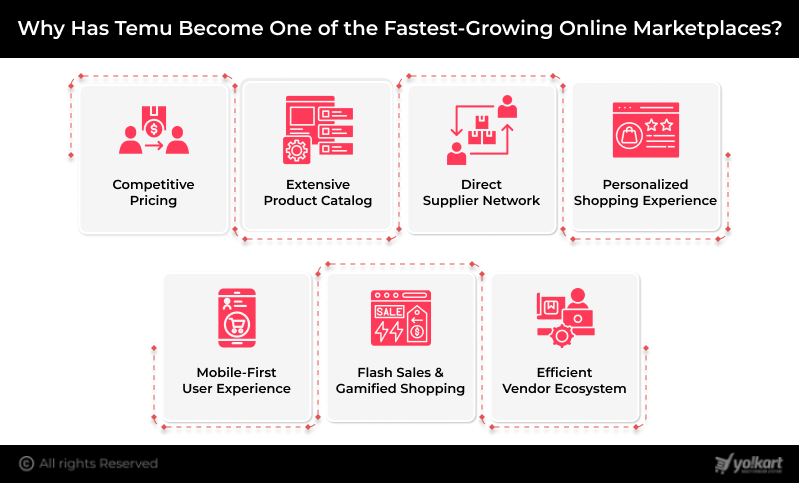
1. Competitive Pricing
By connecting buyers directly with manufacturers and merchants, Temu minimizes intermediaries, allowing products to be offered at lower prices than at many traditional retailers. Combining affordability with a superior customer experience helps attract and retain shoppers.
2. Extensive Product Catalog
Temu offers products across numerous categories, enabling shoppers to purchase everything they need from a single platform. For new marketplace owners, this demonstrates the importance of gradually expanding product offerings while maintaining quality standards and vendor diversity.
3. Direct Supplier Network
Instead of relying on centralized inventory, Temu leverages a large network of independent sellers and manufacturers. This marketplace approach enables rapid expansion without requiring significant investments in warehousing or inventory management. For entrepreneurs, attracting reliable vendors often plays a more important role in marketplace success than simply increasing product listings.
4. Personalized Shopping Experience
Modern shoppers expect personalized experiences. Temu enhances product discovery through recommendation engines, browsing history, trending products, and category-based suggestions. These personalization features improve user engagement, increase average order values, and encourage repeat purchases.
5. Mobile-First User Experience
A significant portion of online shopping now happens on smartphones. Temu’s mobile-first design offers intuitive navigation, quick search, streamlined checkout, and optimized browsing, making shopping convenient across devices. Businesses planning to launch a marketplace should prioritize responsive design and mobile applications from the beginning to maximize customer engagement.
6. Flash Sales and Gamified Shopping
Limited-time deals, countdown offers, reward programs, and interactive promotions create urgency and encourage users to make purchasing decisions more quickly. Gamification also improves customer retention by making the shopping experience more engaging than traditional online stores.
7. Efficient Vendor Ecosystem
Behind every successful marketplace is a robust vendor management system. Efficient seller onboarding, product approvals, order management, commission handling, and communication tools enable marketplace operators to scale while maintaining operational efficiency. Investing in strong vendor management capabilities is essential for long-term marketplace growth.
Build a Marketplace Inspired by Proven Growth Strategies
Can You Build an eCommerce Marketplace Like Temu?
The short answer is yes.
Today, entrepreneurs have access to advanced marketplace technologies that make launching a multi-vendor marketplace significantly easier than it was just a few years ago. Instead of investing extensive time and resources in developing every feature from scratch, businesses can choose an approach that aligns with their budget, timeline, and long-term goals.
Broadly, there are two primary ways to build a marketplace similar to Temu.
Option 1: Custom Marketplace Development
With custom development, the entire platform is built according to your specific business requirements. This approach offers complete flexibility over the design, functionality, integrations, and user experience.
Moreover, custom development is often preferred by organizations with highly specialized workflows or unique marketplace requirements that cannot be met by existing solutions.
However, this flexibility comes with several trade-offs:
- Higher development costs
- Longer implementation timelines
- Larger technical teams
- Continuous maintenance and upgrades
- Increased project risks
For startups and growing businesses, building an entire marketplace from the ground up can significantly delay market entry.
Option 2: White-Label Marketplace Software
White-label marketplace software offers a faster and more cost-effective alternative. Instead of developing fundamental marketplace functionality from scratch, businesses start with a pre-built platform that already includes the essential features required to operate a successful multi-vendor marketplace.
Modern white-label solutions typically provide:
- Buyer and seller dashboards
- Vendor management
- Product catalog management
- Commission management
- Payment integrations
- Order management
- Marketing tools
- Mobile responsiveness
- Multi-language and multi-currency support
This approach enables entrepreneurs to launch faster, reduce development costs, and minimize technical risks while retaining the flexibility to scale as their business grows.
Which Development Approach Should You Choose?
The ideal development approach depends on your business objectives, budget, and launch timeline.
If your marketplace requires entirely custom workflows or proprietary functionality, custom development may be appropriate despite the higher investment.
However, if your goal is to launch quickly, validate your business idea, and scale efficiently, choosing a proven white-label marketplace platform is often the more practical option.
For that, solutions like Yo!Kart is the go-to choice. It is specifically designed to help entrepreneurs build scalable multi-vendor marketplaces without reinventing core marketplace functionality. By providing a comprehensive set of built-in marketplace features and customization capabilities, Yo!Kart enables businesses to focus on vendor acquisition, customer growth, and revenue generation rather than lengthy software development cycles.
The next section outlines the step-by-step process for building an eCommerce marketplace like Temu, from selecting the right niche to launching and growing your platform successfully.
Step-by-Step Guide to Build an eCommerce Marketplace Like Temu
Building a successful marketplace like Temu requires more than developing a feature-rich website. The real challenge lies in creating a platform that attracts quality sellers, delivers a seamless shopping experience, and scales efficiently as your business grows. A strategic approach during the planning and development stages can help you reduce risks, optimize costs, and accelerate your launch.
Here’s a step-by-step roadmap to help you build an eCommerce marketplace inspired by Temu.
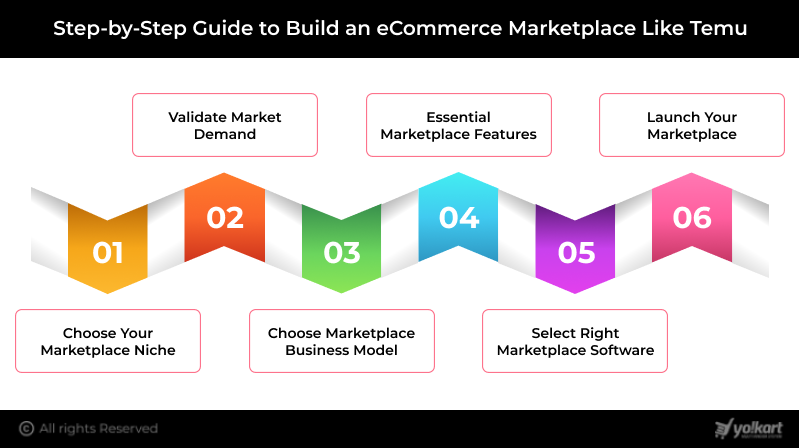
Step 1: Choose Your Marketplace Niche
The first step is to define the niche your marketplace will serve. While Temu offers products across multiple categories today, its initial success came from targeting value-conscious shoppers before expanding its product offerings.
Instead of trying to compete with established global marketplaces immediately, consider launching with a focused niche. This approach helps you build a loyal customer base, establish your brand, and streamline vendor acquisition.
Popular marketplace niches include:
- Fashion and Apparel
- Electronics and Gadgets
- Home & Living
- Beauty and Personal Care
- Health and Wellness
- Automotive Parts & Accessories
- Handmade Products
- Industrial and B2B Supplies
- Baby Products
- Pet Supplies
- Sports & Outdoor Equipment
When selecting a niche, evaluate factors such as market demand, competition, supplier availability, customer purchasing behavior, and long-term growth potential.
Pro Tip: Starting with a niche marketplace allows you to validate your business model more quickly. Once your platform gains traction, you can gradually expand into additional product categories.
Step 2: Validate Market Demand
Before investing in development, validate your concept through market research to ensure your target audience genuinely needs your platform. Thorough market research helps minimize business risks and uncover opportunities to differentiate your platform.
Some effective validation methods include:
- Conduct Competitor Analysis
Study successful marketplaces operating in your niche. Analyze their strengths, weaknesses, pricing strategies, seller ecosystem, customer reviews, and unique selling propositions. This helps identify market gaps that your marketplace can address.
- Perform Keyword Research
Use SEO tools to identify high-demand search queries related to your niche. Understanding search behavior can validate market interest while shaping your long-term content strategy.
- Understand Customer Pain Points
Engage and gather feedback from potential buyers through surveys, interviews, online communities, or social media discussions. Learn about their challenges with existing marketplaces and identify opportunities to deliver a better shopping experience.
- Evaluate Vendor Interest
Speak with manufacturers, wholesalers, distributors, and retailers to understand their expectations regarding commissions, onboarding, logistics, and marketing support.
Market validation minimizes business risks and ensures you’re building a marketplace that addresses genuine customer and seller needs.
Step 3: Choose the Right Marketplace Business Model
One of the key reasons behind Temu’s success is its scalable marketplace business model. Before developing your platform, determine how your marketplace will generate revenue.
Many successful marketplaces diversify their income by combining multiple monetization strategies.
- Commission-Based Model
The marketplace earns a percentage of every successful transaction completed by sellers. This is one of the most widely adopted marketplace revenue models because it aligns the platform’s success with seller performance.
- Subscription Plans
Offer premium membership plans that provide sellers with additional benefits such as increased product listings, advanced analytics, marketing tools, or priority support.
- Featured Listings
Allow sellers to pay for increased product visibility through featured placements, homepage banners, sponsored categories, or promotional campaigns.
- Advertising Revenue
As your marketplace grows, brands and sellers may pay to advertise their products or services across your platform, creating an additional revenue stream.
- Transaction or Service Fees
You may also charge fixed service fees, payment processing fees, or convenience charges depending on your marketplace’s business model.
Many leading marketplaces combine these strategies to build sustainable and diversified revenue streams while maintaining competitive pricing for sellers.
Step 4: Define the Essential Marketplace Features
A successful marketplace should provide an intuitive shopping experience for buyers, efficient management tools for sellers, and complete operational control for administrators. Planning these features early ensures your platform can support future business growth.
Essential features include:
- Advanced Product Search & Filters
- Multi-Vendor Store Management
- Product Catalog Management
- Secure Checkout
- Multiple Payment Gateways
- Order & Inventory Management
- AI-Powered Product Recommendations
- Ratings & Reviews
- Commission Management
- Discounts & Promotional Tools
- Reports & Analytics
- Multi-Language & Multi-Currency Support
Power Your Temu-Inspired Marketplace with Proven Functionality
Step 5: Choose the Right Marketplace Software
Selecting the right technology foundation is one of the most important decisions you’ll make. Your marketplace software will directly influence development costs, launch timelines, scalability, and future customization possibilities.
Most entrepreneurs consider two primary approaches.
| Criteria | Custom Marketplace Development | White-Label Marketplace Software |
|---|---|---|
| Development Time | 8-18 months or longer | A few days to weeks |
| Development Cost | High upfront investment | Lower and more cost-effective |
| Customization | Fully customizable from scratch | Highly customizable with built-in features |
| Features | Developed individually based on requirements | Pre-built multi-vendor marketplace functionality |
| Maintenance & Risk | Requires ongoing maintenance with higher project risk | Lower technical risk with easier maintenance |
| Best For | Businesses with unique or complex requirements | Entrepreneurs seeking faster launch and scalability |
Step 6: Build Your Vendor Network and Launch Your Marketplace
Even the most advanced marketplace cannot succeed without quality vendors and effective marketing. Once your platform is ready, your focus should shift toward attracting sellers, acquiring customers, and continuously improving the user experience.
1. Build a Strong Vendor Network
Attract quality merchants by offering:
- Simple registration process
- Dedicated onboarding support
- Competitive commission structures
- Promotional incentives for early sellers
- Educational resources for vendors
- Transparent marketplace policies
Establishing trust with sellers early creates a stronger product catalog and improves customer confidence in your marketplace.
2. Prepare for Launch
Before going live, thoroughly test every aspect of your marketplace, including:
- User registration
- Product listings
- Shopping cart functionality
- Payment processing
- Order management
- Notifications
- Mobile responsiveness
- Site speed
- Security
A smooth launch experience helps establish credibility from day one.
3. Execute a Multi-Channel Marketing Strategy
After launch, invest in marketing initiatives that attract both buyers and sellers. Your marketing strategy may include:
- Search Engine Optimization (SEO)
- Pay-Per-Click (PPC) advertising
- Content marketing
- Email marketing
- Social media campaigns
- Influencer collaborations
- Affiliate partnerships
- Referral programs
Consistently publishing educational content, product guides, buying tips, and marketplace resources can also help improve organic visibility while building trust with potential customers.
4. Gather Feedback and Optimize
Launching your marketplace is just the beginning. Continuously collect feedback from buyers and sellers to identify usability issues, improve platform performance, and introduce new features based on user needs. Successful marketplaces evolve by refining customer experiences, simplifying seller operations, and adapting to changing market trends.
A combination of the right marketplace software, quality vendors, and ongoing optimization lays the foundation for building a scalable and successful marketplace like Temu.
Essential Features of a Marketplace Like Temu
The success of a marketplace depends on its ability to deliver a seamless experience for buyers, sellers, and administrators alike. While Temu’s rapid growth can be attributed to its pricing strategy and marketing efforts, its technology foundation also plays a significant role in creating an engaging shopping experience.
When building a marketplace like Temu, ensure your platform includes the following essential features.
| Buyer Features | Seller Features | Admin Features | Growth & Engagement Features |
|---|---|---|---|
| Advanced Product Search | Vendor Dashboard | Vendor Management | AI-Based Product Recommendations |
| Product Categories & Filters | Product Management | Commission Management | Flash Sales |
| Wishlist | Inventory Management | Product Approval | Coupons & Discount Management |
| Shopping Cart | Order Management | Order Management | Referral Programs |
| Secure Checkout | Sales Reports | User Management | Loyalty Programs |
| Multiple Payment Methods | Discount Management | Reports & Analytics | Push Notifications |
| Ratings & Reviews | Return Management | Content Management | Personalized Recommendations |
| Order Tracking | Customer Communication | Marketing Tools | Email Campaigns |
| Multi-language Support | Store Analytics | Multi-language & Multi-currency | Promotional Campaigns |
While these features form the foundation of a successful marketplace, selecting software that already includes most of these capabilities can significantly reduce development time and implementation costs.
How Much Does it Cost to Build a Marketplace Like Temu?
One of the first questions entrepreneurs ask is, “How much does it cost to build a marketplace like Temu?”
The answer depends on several factors, including the development approach, feature complexity, design requirements, third-party integrations, customization needs, and long-term scalability.
Here’s a general cost comparison of the available development approaches:
| Development Approach | Estimated Cost | Estimated Timeline |
|---|---|---|
| Custom Marketplace Development | $80,000-$300,000+ | 8-18 Months |
| White-Label Marketplace Software | $1,000-$10,000+ | A Few Days to Weeks |
| SaaS Marketplace Builder | Monthly Subscription | Quick Launch |
While custom development provides complete flexibility, it often requires a significant investment in software development, testing, infrastructure, and ongoing maintenance.
In contrast, white-label marketplace software enables businesses to launch much faster by providing pre-built marketplace functionality that can be customized according to business requirements.
Factors That Influence Development Cost
The overall cost of building a marketplace depends on several variables, including:
- Number of buyer and seller features
- UI/UX design customization
- Mobile application development
- Third-party API integrations
- Payment gateway integrations
- Shipping and logistics integrations
- Multi-language and multi-currency support
- Security and compliance requirements
- Performance optimization
- Ongoing maintenance and feature enhancements
When estimating your budget, consider not only the initial development cost but also the total cost of ownership (TCO), including maintenance, infrastructure, upgrades, and future customization. Choosing a scalable marketplace solution can help reduce long-term costs while supporting business growth.
Common Challenges in Building a Marketplace Like Temu
Building a marketplace like Temu involves more than developing a feature-rich platform. Entrepreneurs must create a balanced ecosystem where buyers and sellers can thrive while ensuring operational efficiency and sustainable growth. Below are some of the most common challenges businesses face and practical ways to overcome them.
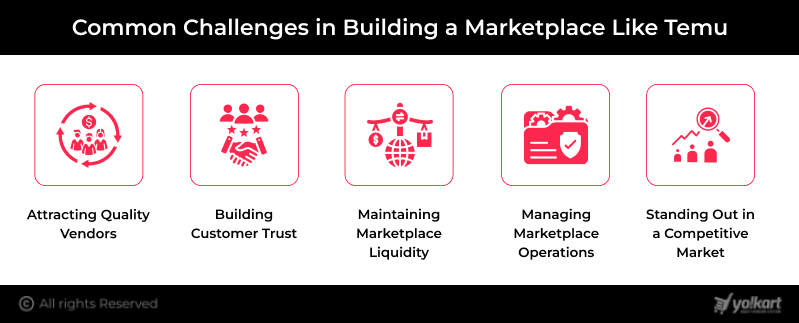
1. Attracting Quality Vendors
A marketplace’s success depends on the quality and diversity of its sellers. Without a reliable vendor network, it becomes difficult to offer a compelling product selection and attract customers.
Solution: Implement a seller-friendly onboarding process, offer competitive commission structures, provide marketing support, and create clear marketplace policies to encourage reputable vendors to join and grow on your platform.
2. Building Customer Trust
Customers are more likely to purchase from marketplaces that demonstrate credibility. Buyers are often hesitant to purchase from unfamiliar platforms without confidence in product quality, sellers, and transactions.
Solution: Strengthen credibility by offering secure payment processing, transparent return policies, verified seller profiles, authentic product reviews, and responsive customer support to create a safe shopping experience.
3. Maintaining Marketplace Liquidity
One of the biggest challenges for new marketplaces is balancing buyer demand with seller supply, especially during the early stages of a marketplace. An imbalance can lead to low engagement and fewer successful transactions.
Solution: Launch with a focused niche, onboard quality vendors, and execute targeted marketing campaigns to build a steady flow of buyers and sellers before expanding into additional categories.
4. Managing Marketplace Operations
As your marketplace grows, manually managing vendors, orders, commissions, disputes, and product approvals becomes increasingly complex and time-consuming.
Solution: Adopt marketplace software with built-in automation for vendor management, order processing, commission tracking, reporting, and customer support to streamline daily operations and improve efficiency.
5. Standing Out in a Competitive Market
With countless online marketplaces competing for the same audience, differentiating your platform and building a unique value proposition can be challenging.
Solution: Focus on a niche market, deliver an exceptional user experience, offer unique seller and buyer benefits, and continuously innovate your platform to establish a strong competitive advantage.
Why Choose Yo!Kart to Build a Marketplace Like Temu?
Building a marketplace like Temu from scratch requires months of planning, development, testing, and financial investment. From developing buyer and seller interfaces to implementing vendor management, payment processing, order management, and marketing tools, custom development can take months before your platform is ready to launch.
Yo!Kart is a self-hosted multi-vendor marketplace software that stands out as a faster and more cost-effective alternative. It is designed to help businesses launch scalable online marketplaces across various industries. Whether you’re building a B2C, B2B, wholesale, or niche marketplace, it offers a comprehensive set of marketplace features that can be customized to suit your unique business requirements.
Some of the key advantages include:
- Self-hosted solution with complete source code ownership
- Ready-to-use multi-vendor marketplace functionality
- Buyer, seller, and admin dashboards
- Mobile-responsive design
- Multi-language and multi-currency support
- Flexible commission management
- Secure payment gateway integrations
- Built-in marketing and promotional tools
- SEO-friendly architecture
- Easy customization and scalability
- One-time license with no recurring subscription fees
Instead of spending months developing core marketplace functionality, entrepreneurs can leverage Yo!Kart’s proven framework to accelerate development and focus on growing their marketplace ecosystem. With its extensive customization capabilities and scalable architecture, businesses can focus on onboarding sellers, acquiring customers, and growing their marketplace while adapting the platform to evolving business needs.
Schedule a One-on-One Personalized Demo to See Yo!Kart in Action
Conclusion
Temu’s rapid success demonstrates the growing demand for marketplace business models that connect buyers with a diverse network of sellers through a seamless digital experience. While replicating Temu’s scale requires continuous innovation and long-term investment, entrepreneurs can certainly build successful marketplaces by adopting the right strategy and technology.
The foundation of a successful marketplace lies in selecting a profitable niche, validating market demand, defining an effective business model, and implementing features that create value for both buyers and sellers. Equally important is choosing a scalable marketplace solution that enables businesses to launch faster, reduce development costs, and adapt to future growth.
If you’re planning to build an eCommerce marketplace inspired by Temu, investing in a robust white-label marketplace solution like Yo!Kart provides the features, flexibility, and scalability needed to launch quickly and grow confidently. With a proven technology foundation, you can focus on attracting vendors, engaging customers, and scaling your marketplace instead of building core functionality from scratch.
Frequently Asked Questions
1. How long does it take to build a marketplace like Temu?
The timeline to build a marketplace like Temu depends on the development approach you choose. A custom-built marketplace may take anywhere from 8 to 18 months, while a white-label marketplace solution can typically be launched within a few days to a few weeks, depending on the level of customization required.
2. How much does it cost to build a marketplace like Temu?
Development costs to build a marketplace like Temu vary based on feature requirements and the chosen approach. Custom development can cost between $80,000 and $300,000 or more, whereas white-label marketplace software generally offers a significantly more cost-effective option.
3. Can I build a marketplace like Temu without coding?
Yes, you can build a marketplace like Temu without coding. White-label marketplace software enables entrepreneurs to launch and manage a multi-vendor marketplace without building the platform from scratch. Most solutions like Yo!Kart includes pre-built functionality that can be customized according to business needs.
4. What are the essential features of a Temu-like marketplace?
A Temu-like marketplace should include the following features:
- Multi-vendor management
- Product catalog management
- Secure payments
- Advanced search
- Order tracking
- Commission management
- Seller dashboards
- Customer reviews
- Promotional tools
- Analytics
5. Is white-label marketplace software better than custom development?
The right choice depends on your business goals. White-label software is ideal for businesses looking to launch quickly and reduce development costs, while custom development is better suited for businesses requiring highly specialized requirements or complex workflows.
6. Which industries can use the marketplace model?
The marketplace model can be applied across numerous industries, including:
- Fashion
- Electronics
- Wholesale
- Automotive
- Healthcare
- Home décor
- Beauty
- Industrial supplies
- Food
- Digital products
7. Can Yo!Kart be customized to build a marketplace like Temu?
Yes, Yo!Kart is a customizable, self-hosted multi-vendor marketplace software that enables businesses to build marketplaces inspired by platforms like Temu while tailoring the design, features, workflows, and integrations to their specific business requirements.
Build, Launch, and Grow Your eCommerce Marketplace Like Temu
Get StartedPopular Posts