
Back To Home

How to Transform an Online eCommerce Store into a Multi-Vendor Marketplace Platform
674
Views
Published Date 21st April, 2026
The modern eCommerce industry has evolved far beyond basic online stores. What began as simple online storefronts selling limited inventories has now expanded into vast digital ecosystems powered by network effects, third-party sellers, and scalable technology infrastructures. This shift has changed how modern businesses scale online.
Industry giants like Amazon and eBay did not achieve global dominance by merely selling their own products. Instead, they leveraged the multi-vendor marketplace model, enabling thousands of independent sellers to list and sell products on their platforms. Leveraging this approach, they were able to expand product catalogs exponentially, reduce inventory risks, and create self-sustaining ecosystems that grow stronger with every new vendor.
If you are an entrepreneur running a traditional eCommerce website or single-vendor store, this shift represents a powerful opportunity. Transitioning your existing website or a single-seller model to a marketplace model can unlock new revenue streams, accelerate growth, and position your business for long-term scalability. With the right strategy and technology, your store can evolve into a scalable marketplace business.
Table of Contents
- What is a Multi-Vendor Marketplace?
- Why Convert Your eCommerce Store into a Marketplace?
- When Should You Turn Your eCommerce Store Into a Marketplace?
- Key Features Required in a Multi-Vendor Marketplace
- Challenges in Converting an eCommerce Website
- Best Way to Convert: Use a Ready-Made Multi-Vendor Marketplace Software
- Yo!Kart: Best Solution to Build a Multi-Vendor Marketplace
- Conclusion
What is a Multi-Vendor Marketplace?
A multi-vendor marketplace is an online platform that enables multiple independent sellers to register, showcase their products, and sell directly to customers, while the platform owner facilitates the entire ecosystem.
Unlike a traditional eCommerce website, where you are responsible for sourcing, stocking, and shipping products, a marketplace decentralizes these responsibilities among vendors. They manage their own inventory and fulfillment, while your platform provides visibility, infrastructure, and trust.
Think of It This Way:
- A single-vendor store = You sell your own products
- A marketplace = You build the mall, and others open shops inside it
This shift changes your role from a seller to a platform owner, a far more scalable and profitable position.
Core Components of a Marketplace
- Vendor onboarding and management: Smooth seller registration, approvals, and account management.
- Product listing and catalog management: Tools for vendors to add, update, and organize products.
- Unified checkout system: Customers can purchase from multiple sellers through one seamless checkout.
- Commission and payment distribution: Automated commission settings and payout management for vendors.
- Ratings, reviews, and trust mechanisms: Features that build credibility and improve buyer trust.
This model thrives on network effects: the more vendors you have, the more products you offer; the more products you offer, the more customers you attract.
Unlock Growth With a Multi-Vendor Marketplace Model
Why Convert Your eCommerce Store into a Marketplace?
Transitioning to a multi-vendor marketplace is not just a passing trend. It is a strategic move that offers several long-term advantages. Instead of relying only on your own products, you build a platform where multiple sellers contribute to growth.
1. Expand Product Catalog Without Inventory
One of the biggest limitations of a traditional eCommerce website is inventory management. By allowing third-party sellers to list products, you can significantly expand your catalog without investing in stock.
2. Generate Multiple Revenue Streams
A multi-vendor marketplace can earn revenue through several channels, such as:
- Commission on each sale
- Vendor subscription fees
- Featured listings
- Advertising revenue
This diversification in revenue streams reduces dependency on product sales alone.
3. Reduce Operational Burden
Managing inventory, warehousing, and logistics can be resource-intensive. In a marketplace model, vendors handle these aspects, allowing you to focus on platform growth, user experience, and marketing.
4. Scale Faster with Vendor Network
Growth becomes exponential as more vendors join your platform. Each new seller brings additional products, attracts customers, and increases the visibility of your marketplace.
5. Increase Customer Retention
A wider product range and competitive pricing improve customer satisfaction. This encourages repeat purchases, long-term loyalty, and better retention.
Suggested Read: Why Scaling to a Multivendor Marketplace is the Right Choice
When Should You Turn Your eCommerce Store Into a Marketplace?
Not every business is ready to become a marketplace, but certain indicators clearly indicate when it is the right time to make the shift:
1. Limited Inventory Growth
If your product expansion has slowed due to storage limitations, supplier constraints, or capital investment, it’s a strong signal. A marketplace model allows you to bypass these restrictions by enabling third-party sellers to list their products, instantly expanding your catalog without additional inventory burden.
2. High Product Demand but Low Supply
When customers frequently search for products you don’t offer, you’re leaving revenue on the table. Instead of sourcing every item yourself, a multi-vendor marketplace lets external vendors fill these gaps, helping you capture unmet demand while improving customer satisfaction.
3. Increasing Operational Costs
Rising expenses in warehousing, logistics, and inventory management can quickly eat into your margins. By transitioning to a marketplace model, you shift these responsibilities to vendors, allowing you to operate more efficiently and focus on scaling the platform.
4. Desire to Scale Without Owning Stock
If your goal is rapid growth with minimal financial risk, owning inventory becomes a bottleneck. A marketplace model removes this limitation, enabling you to scale through vendor participation rather than capital-intensive stock management.
In short, when growth starts being limited by inventory, cost, or operational complexity, it’s a clear indication that your business is ready to transition into a more scalable marketplace model.
Turn Growth Limits Into Marketplace Opportunities
Key Features Required in a Multi-Vendor Marketplace
To successfully convert your ecommerce website into a marketplace, you need a robust feature set that supports both vendors and customers.
| Feature Category | Key Features | Why It Matters |
| Vendor Management System | Vendor registration Smooth onboarding Seller dashboards Performance analytics |
Helps vendors join easily, manage operations, and track growth |
| Product Management | Multi-vendor listings Category management Bulk product uploads |
Keeps product catalogs organized and simplifies product listing |
| Order & Inventory Management | Real-time order tracking Inventory sync Automated alerts |
Improves order accuracy and keeps sellers updated |
| Payment & Commission System | Split payments Configurable commissions Multiple payment gateways |
Ensures smooth financial transactions between all parties |
| User Experience Features | Advanced search Filters Reviews and ratings Wishlists Recommendations |
Enhances shopping experience and boosts engagement |
| Admin Controls | Vendor approvals Commission settings Reports Analytics Dispute management |
Gives admins full control over marketplace operations |
| Scalability & Performance | High traffic handling Growing vendor support Stable architecture |
Supports long-term growth without performance issues |
| Security & Trust | Secure payments User verification Fraud protection |
Builds trust among buyers and sellers |
Suggested Read: Top Features a Modern Multi-Vendor Marketplace Should Have
Challenges in Converting an eCommerce Website
While turning an eCommerce website into a multi-vendor marketplace offers major growth potential, the transition is not that simple. Expanding from a single-seller model to a marketplace with multiple vendors introduces technical, operational, and management challenges that require the right planning and technology.
1. Technical Complexity
Transforming your existing store into a multi-vendor system requires major architectural changes. You need to redesign workflows for product management, order processing, vendor roles, and permissions. Without the right foundation, this can quickly become difficult to manage and maintain.
2. Vendor Management System
Introducing multiple sellers adds an entirely new layer of complexity and responsibility. From onboarding vendors and verifying their profiles to monitoring performance and maintaining quality standards, managing a marketplace requires robust control mechanisms. Most traditional eCommerce stores are not built for this level of seller management.
3. Payment Splitting & Commissions
Handling payments in a multi-vendor environment is significantly more complex than a standard eCommerce setup. You need secure and reliable systems to split payments between sellers, manage commissions, process payouts, and handle refunds or disputes smoothly. Without this, trust and efficiency can suffer.
4. Scalability Issues
As your marketplace grows, so do its technical demands. Increased traffic, multiple vendors, and higher transaction volumes require a platform that can scale without performance issues. Many traditional eCommerce setups struggle to handle this level of complexity.
5. Long Development Time
If you rely on custom development or heavy plugin modifications, the process can become time-consuming and resource-intensive. It may take months to implement, test, and stabilize the system, delaying your time-to-market.
The Real Challenge
Most businesses try to convert their existing store using plugins or manual development, but this often leads to limited functionality, performance issues, and scalability constraints. To build a successful marketplace, you need software designed specifically for multi-vendor operations from the start.
Simplify Your eCommerce Website to Marketplace Transition
Best Way to Convert: Use a Ready-Made Multi-Vendor Marketplace Software
For most entrepreneurs, the smartest and most efficient way to convert an existing eCommerce website into a marketplace is by using a ready-made multi-vendor marketplace software.
Instead of developing your platform from scratch or relying on multiple plugins that may not integrate well, ready-made solutions offer a complete, unified framework specifically designed for marketplace operations. This approach not only simplifies the transition but also ensures long-term scalability and stability.
Why Ready-Made Solutions Are Better
- Faster Deployment
Ready-made solutions significantly reduce development time, allowing you to launch your marketplace in weeks instead of months. This faster time-to-market helps you start onboarding vendors and generating revenue early.
- Lower Cost
Custom development involves high upfront investment and ongoing maintenance costs. In contrast, ready-made solutions eliminate most of these expenses, making them a cost-effective choice for startups and growing businesses.
- Built-In Marketplace Features
You get all essential marketplace functionalities, including:
- Vendor onboarding and management
- Commission and payment systems
- Product and order management
- Reviews and ratings
This removes the need to build or integrate multiple systems separately.
- Proven Architecture
These platforms are specifically designed for multi-vendor environments and are already tested for real-world use cases. This ensures better performance, fewer technical issues, and a more reliable user experience.
Yo!Kart: Best Solution to Build a Multi-Vendor Marketplace
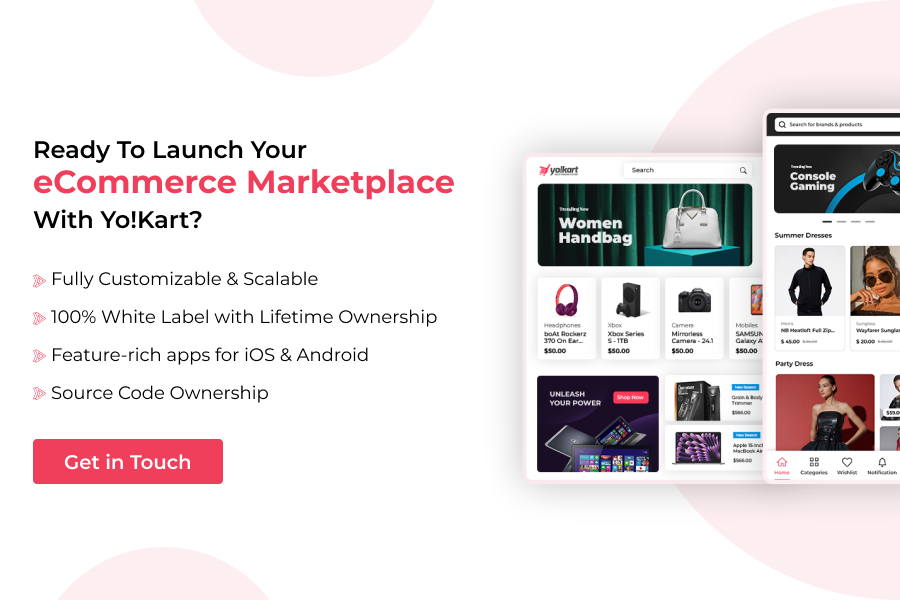
When it comes to turning an eCommerce website into a fully functional multi-vendor marketplace, Yo!Kart stands out as a powerful and dependable solution. Unlike plugins or extensions that try to add marketplace functionality to an existing store, Yo!Kart is a purpose-built system designed from the ground up for multi-vendor operations. This means vendors, admins, and customers can interact through one seamless system without relying on multiple third-party tools. The result is a more stable, scalable, and efficient platform built for long-term growth.
Key Benefits of Yo!Kart
- Quick Deployment
Yo!Kart enables you to launch your marketplace quickly without rebuilding your platform from scratch. This allows you to enter the market faster and start generating revenue sooner.
- Fully Customizable & White Label
The solution offers complete flexibility to align with your brand identity. From design to functionality, everything can be tailored to your business needs.
- Self-Hosted Solution
Yo!Kart’s self-hosted model gives you full ownership of your marketplace platform. It gives you better control over data, customizations, integrations, and operations without depending on third-party providers or recurring platform restrictions.
- Advanced Vendor Management
Yo!Kart provides a comprehensive system to manage vendor onboarding, performance tracking, commission control, and dedicated dashboards. These tools help admins manage sellers efficiently while giving vendors everything needed to grow sales.
- Built-In Payment & Commission System
Yo!Kart includes integrated payment solutions with automatic commission handling, eliminating the need for third-party workarounds.
- Scalable Architecture
Whether you’re a startup or an enterprise, Yo!Kart can scale with your business, supporting increasing traffic, vendors, and transactions.
- Mobile-Ready Platform
With mobile commerce on the rise, Yo!Kart ensures your marketplace is optimized for all devices, delivering a seamless user experience.
Schedule a Personalized Demo to See Yo!Kart in Action
Conclusion
Moving from a traditional eCommerce website to a multi-vendor marketplace is not just a technological upgrade. It is a strategic transformation that can redefine your business growth trajectory. Instead of relying only on your own inventory, you can expand product offerings, create multiple revenue streams, reduce daily operational pressure, and scale faster.
That said, the transition requires the right strategy and technology. While custom development and plugin-based solutions may seem viable, they often introduce limitations, delays, and unnecessary complexity. Whereas, a ready-made multi-vendor marketplace software like Yo!Kart provides a streamlined, cost-effective, and scalable solution, enabling you to launch and grow your marketplace with confidence.
Want to Convert Your eCommerce Website into a Multi-Vendor Marketplace?
Get In TouchPopular Posts